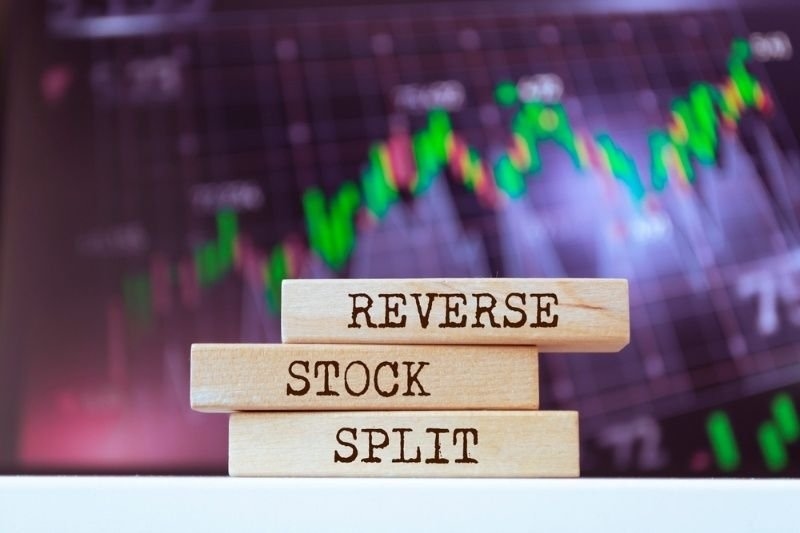
Ever logged into your brokerage account and noticed you suddenly own way fewer shares of a stock than you did yesterday? Don't panic, you probably didn't lose money. You just witnessed a reverse stock split. It's one of those corporate moves that sounds scary on the surface but is usually just financial bookkeeping dressed up as a big event. Reverse Stock Splits confuse many investors, mainly because the name itself feels backward. So let's break down what's actually happening, why companies bother doing this, and how you should think about it the next time one shows up in your portfolio.
Think of it like exchanging ten $1 bills for a single $10 bill. Nothing about your wealth changes; you're just holding fewer, bigger units of the same value. That's essentially what a reverse stock split does to shares.
A company announces a ratio, such as "1-for-5" or "1-for-10," and every existing group of shares is rolled into one new share. Own 50 shares before a 1-for-5 split? You'll have 10 afterward, each worth roughly five times what they were before.
People also call this a stock consolidation or a share rollback, and it's the opposite of a regular stock split, where companies split shares to make them cheaper and more accessible.
Here's the part that trips people up: exchanges like the NYSE and Nasdaq don't want to list stocks trading for pennies. If a company's share price sits below $1 for 30 straight trading days, it gets a warning and roughly six months to fix things, or risk getting booted off the exchange entirely.
The math isn't complicated, even if the concept feels weird at first.
Say you're holding 10,000 shares priced at 50 cents each. After a 1-for-10 split, you'd walk away with 1,000 shares, and each one should now trade around $5. Your total position is still worth roughly the same amount; it's just sliced differently.
Ratios vary a lot depending on how far a stock has fallen. Some companies only need a mild 1-for-2 split. Others, especially ones whose stock has cratered, might go as extreme as 1-for-100.
Nobody wakes up excited to announce a reverse split. It's usually a defensive move, though not always a desperate one. A few common reasons drive the decision:
That said, most investors see reverse splits as a red flag first and a strategic tool second, and honestly, that instinct isn't always wrong.
Must Try: Blockchain ETF: A Comprehensive Guide for Investors in 2026
Making money off a reverse split isn't impossible, but it takes more homework than most people expect. A few things worth checking before you jump in:
Let's put real numbers to this. Picture a small pharma company with 10 million shares trading at $5 apiece. Investors are getting nervous about the low price, so leadership announces a 1-for-5 reverse split.
Same $50 million, just carved up differently. That's the whole trick behind every reverse split, no matter how dramatic the ratio looks on paper.
Two real-world examples show just how differently this move can play out.
Back in 2002, AT&T pulled off a 1-for-5 reverse split while spinning off its cable division to merge with Comcast. The goal was to protect its stock price and liquidity through a messy transition, and it worked reasonably well.
Barnes & Noble Education tells a rougher story. In 2024, it executed a brutal 1-for-100 reverse split, reducing roughly 2.62 billion shares to about 26.2 million and pushing the price from $2 to $20 overnight. The relief didn't last long, though, as shares fell sharply not long after.
Same corporate action, very different aftermaths, which is exactly why context matters so much here.
Before you buy into a stock that just underwent a reverse split, sit with these risks for a minute:
Before putting real money in, take the time to actually read the financials and listen to what management is saying, not just what the stock chart shows.
Reverse Stock Splits aren't some financial trick designed to fool you; they're just a restructuring of how ownership is divided. Sometimes it's a company fighting to stay listed, and sometimes it's part of a bigger, smarter strategic play. Either way, the real work is looking past the headline number and asking what's actually going on beneath the surface. Do that, and you'll approach the next reverse split announcement with a lot more confidence and a lot less confusion.
Also Read: Bull vs. Bear Markets: What’s the Key Difference?
It is when a company combines a bunch of existing shares into fewer shares, and yes, the new shares become higher priced. After it happens, your total investment value is roughly the same, but you’ll end up owning fewer shares than before, because the ratio the company used changes the math.
Honestly, it depends. Some firms use it more carefully for compliance or for restructuring, such as spin-offs. Other times, it feels like they are buying time. So before deciding it’s automatically “good” or “bad” here, look at what the business is actually doing, the fundamentals.
First, try to understand why the reverse split happened, then keep an eye on fundamentals such as revenue and cash flow. Also, don’t get hooked on the idea that there will be a quick bounce just because the price looks different. Usually, real gains come from actual improvement, not just from price mechanics.
Not right away. Immediately after the split, your total value stays about the same. What changes are in your number of shares and the price per share? Your broker typically adjusts everything automatically, and there’s no tax impact from the split itself.
Exchanges like the NYSE and Nasdaq often use rules that involve a minimum share price, commonly around $1. If a stock sits below that level for a stretch, like 30 straight days, the company risks getting delisted. That’s why a reverse split is a common fix in those situations.