The old dividend-versus-growth debate never really goes away, but it feels especially timely in 2026. Investors in the US market are dealing with a mix of sticky inflation worries, shifting rate expectations, and a market that has become more selective than it looked during earlier rallies. That changes the tone of the conversation. This is no longer just about personal style. It is about what is actually holding up better in the market right now.
At the moment, value-oriented stocks have had the stronger year overall. As of early April, the Russell 1000 Value Index was up 2.4% for the year, while the Russell 1000 Growth Index was down 9.1%, according to reporting from The Wall Street Journal. Reuters also reported this week that US tech has just gone through one of its weakest stretches of relative performance in decades, which helps explain why growth investors have felt more pressure lately.
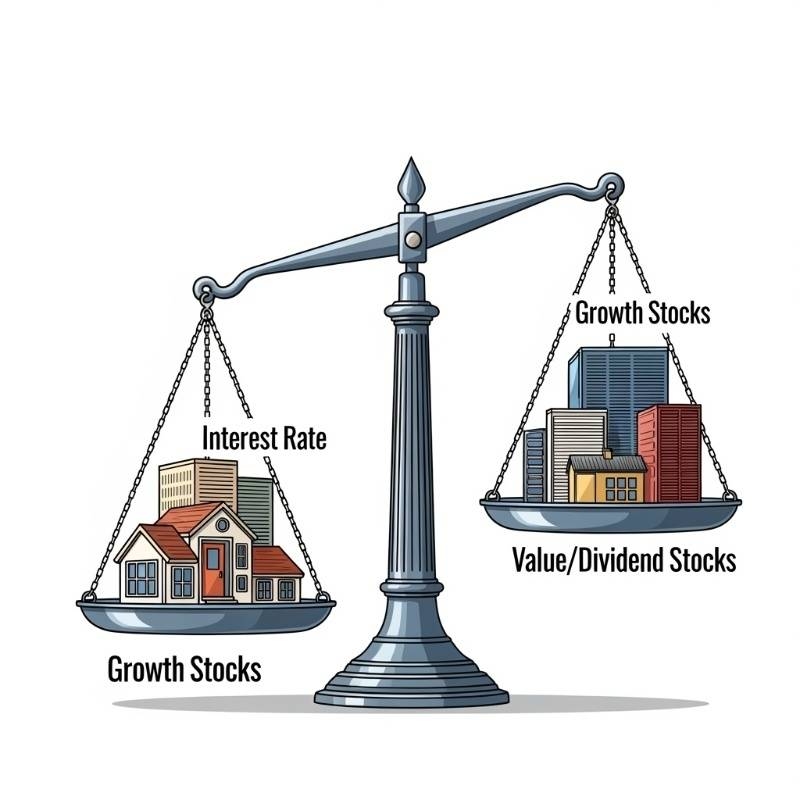
That backdrop matters when looking at dividend vs growth stocks USA because many dividend-focused names sit closer to value territory, while many classic growth names remain concentrated in technology and other rate-sensitive sectors. The result is a market where income and stability have looked more attractive than pure future potential, at least so far this year.
The simplest way to frame the current moment is this: dividend and value strategies have been winning on defense, while growth still carries the stronger long-term upside story if conditions improve. That may sound like a compromise answer, but it is also the most honest one.
Investors have leaned toward dependable cash flow, lower valuations, and sectors that can hold up better when uncertainty rises. Energy has been one of the clearest examples. The S&P 500 energy sector has surged this year as oil prices jumped during the recent Middle East conflict, which has helped value-heavy parts of the market stay afloat.
That is one reason searches around the best dividend stocks 2026 USA and steady income names have picked up. People are not only chasing yield. They are looking for businesses that can return cash while still appearing reasonably priced. In a market where the Federal Reserve kept rates at 3.50% to 3.75% in March and remains cautious because of inflation risks, that preference makes sense.
Dividend stocks are not all the same, and that is where many casual comparisons go wrong. Some are slow, defensive, and built for income. Others are dividend growers with room for both payouts and price appreciation. In today’s market, the second group has looked especially interesting.
Investors have been paying attention to companies and funds that offer:
There is also a practical reason dividend names feel attractive right now. Even broad income funds are offering meaningfully more yield than growth-heavy funds. As of late February, the iShares Russell 1000 Growth ETF showed a trailing 12-month yield of just 0.38%, which highlights how little direct income growth investors usually get while waiting for price appreciation.
That gap feeds the appeal of passive income stocks US investors often talk about. In a more volatile year, getting paid while waiting has emotional value as well as financial value. It can make it easier to stay invested when prices swing around.

Even with weaker performance this year, growth stocks are not suddenly irrelevant. They are simply in a tougher phase. In fact, some strategists now argue that the weakness has created more attractive entry points. Reuters reported this week that Goldman Sachs sees depressed tech valuations as a potential opportunity after one of the sector’s worst relative stretches in 50 years.
That matters because a good growth investing strategy is rarely about buying what already feels comfortable. It is often about identifying when strong businesses are being priced more reasonably than before. Growth investors are still looking at themes such as artificial intelligence, cloud infrastructure, software, semiconductors, and digital platforms. Those themes have not disappeared. They have simply become harder to own during a period when rates and geopolitics are affecting sentiment.
There is also a difference between “growth is losing this year” and “growth is broken.” Those are not the same thing. Morgan Stanley, quoted by MarketWatch this week, said opportunities are beginning to emerge again in quality growth stocks as valuations compress and earnings remain solid.
You May Also Like: Are Debt Funds the Right Investment for You?
A lot of investors treat this as a simple choice between cash flow today and capital gains tomorrow. In reality, the decision is more nuanced. The better question is what kind of market environment the investor expects, and what kind of portfolio behavior they can actually live with.
Dividend-focused investing may suit people who want:
Growth-focused investing may suit people who want:
That is why ideas like a high yield dividend portfolio can look appealing on paper but still require caution. High yield alone is not a sign of quality. Sometimes it signals strength. Other times it reflects a stock price that has fallen for good reason. The best dividend strategies usually balance yield, business quality, and dividend sustainability rather than chasing the biggest number on the screen.
If the question is strictly about what is winning right now, the answer leans toward dividend and value. The clearest evidence is the gap between the Russell 1000 Value Index and the Russell 1000 Growth Index this year, with value ahead and growth still in negative territory as of early April.
Still, the answer gets more interesting when the time frame widens. Growth has recently shown signs of stabilizing, and some investors are already positioning for a rebound if inflation pressure eases and rate fears calm down. Reuters noted that despite recent market turmoil, UBS still expects strong earnings growth and sees AI adoption as a longer-term support for US equities.
So, for now, the scoreboard favors dividend vs growth stocks USA on the dividend side. But that lead comes more from current conditions than from a permanent change in market leadership.
Many investors are no longer choosing one camp exclusively. Instead, they are blending both styles. That approach makes sense in a market where leadership can change quickly and certainty is limited.
A balanced approach might include:
This is where stock market income strategies become more practical than theoretical. Rather than trying to predict the exact next winner, investors are building portfolios that can generate income while still leaving room for upside. That often feels more sustainable than swinging completely from one style to the other every few months.
The same logic applies when discussing the best dividend stocks 2026 USA or growth leaders. The smarter move is often to focus less on labels and more on quality, valuation, earnings durability, and the role each holding plays in the broader portfolio.
Know More: Promising Stocks to Watch in 2026 for Long-Term Investing
The more useful question is not which category sounds better in a headline. It is which one matches the market environment and the investor’s own goals. Someone who wants regular cash flow may naturally lean toward dividends. Someone with a longer time horizon and stronger risk tolerance may still favor growth despite recent pain.
There is no shame in admitting that temperament matters here. A strategy only works if the investor can stick with it. Many people say they want aggressive growth until the drawdowns arrive. Others chase income without checking whether the business can really support the payout. Neither habit tends to end well.
That is why growth investing strategy and dividend investing should both be treated as disciplines, not identities. Each works well in certain seasons. Each struggles in others.
Not always. Many dividend stocks are mature and stable, but a dividend does not guarantee safety. A company can still cut its payout, carry too much debt, or face slowing earnings. Some growth stocks, meanwhile, may have strong balance sheets and powerful long-term advantages even if their share prices are volatile. Safety depends more on business quality, valuation, and cash flow than on whether a stock pays a dividend.
That depends on the goal. Investors focused on building wealth often reinvest dividends because compounding can add a lot over time. Investors using their portfolio for current expenses may prefer taking the cash instead. The choice is not really about right or wrong. It is about whether the portfolio is meant to produce future growth, present income, or a mix of both. That decision shapes how useful dividend payments actually become.
Yes, and for many people that is the most practical setup. A portfolio can use dividend payers to create stability and income while using growth names to pursue stronger upside. The key is being intentional about the mix. If everything is added randomly, the portfolio can feel messy. If each part has a job, the combination can actually improve balance and make it easier to stay invested through changing market cycles.