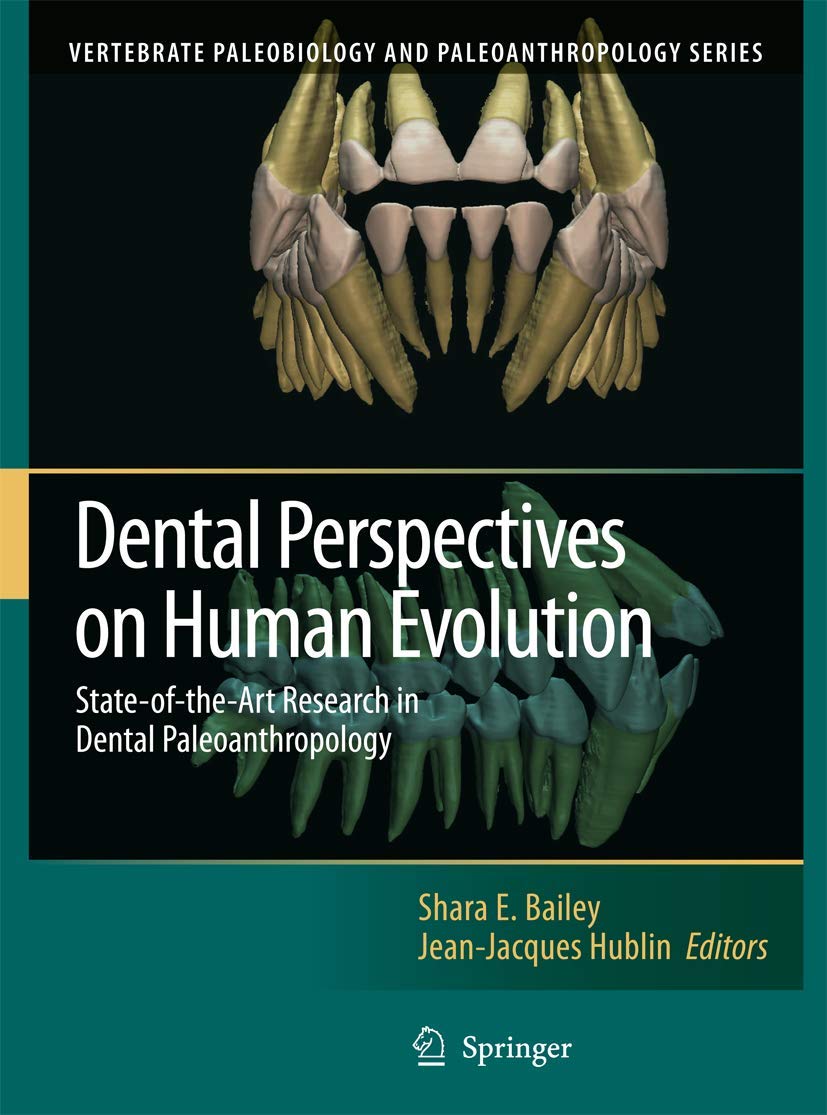
S. E. BAILEY Department of Human Evolution Max Planck Institute for Evolutionary Anthropology Deutscher Platz 6 D-04103 Leipzig, Germany and Center for the Study of Human Origins, Department of Anthropology, New York University, 25 Waverly Place New York, NY 10003, USA sbailey@nyu. edu J. -J. HUBLIN Department of Human Evolution Max Planck Institute for Evolutionary Anthropology Deutscher Platz 6 D-04103 Leipzig, Germany hublin@eva. mpg. de When faced with choosing a topic to as teeth represent, by far, the most abundant be the focus of the first symposium material documenting different species of in Human Evolution at the Max Planck extinct non-human primates and hominins. As Institute for Evolutionary Anthropology in such, much of what we know about non- Leipzig, a paleoanthropological perspective human primate and hominin evolution is based of dental anthropology was a natural choice. on teeth. Teeth make up a disproportionate number Teeth have been a focus of interest for of the fossils discovered. They represent physical anthropologists over many gen- strongly mineralized organs of compact shape, ations. Teeth provide a multitude of which allow better preservation in geological information about humans – including deposits and archaeological sites than any cultural treatment, pathology, morphological other part of the skeleton. As a result, variation, and development. The presence of since the discoveries of the first fossils of culturally induced wear (toothpick grooves, extinct species, vertebrate paleontology has for example) reveals something about what been built primarily on analyses of teeth. From the reviews: "The edited volume is based on the Dental Paleoanthropology symposium which was held in 2005 … . The volume provides invaluable new results, discussions, and synthetic approaches which demonstrate how the study of dentitions can greatly contribute to our knowledge on past human variability and evolution. … Overall it is an excellent volume which contains high quality contributions and is therefore essential to paleoanthropologist, anthropologists, and scholars from various related disciplines. … an invaluable and timely comprehensive account of state-of-the-art research in dental paleoanthropology." Ron Pinhasi, PaleoAnthropology, 2008. "The resulting edited volume is a significant contribution to the fields of dental anthropology and paleoanthropology … . Much of the work presented here is new and should be significant interest to both students and seasoned researchers in dental anthropology and paleoanthropology. In addition, this is an attractive volume, put together with excellent production values, lovely photographs … and well executed and informative line drawings. … will be of great interest and utility to biological anthropologists, paleoanthropologists, and vertebrate paleontologists." Robert L. Anemone, American Journal of Physical Anthropology, 2009. " This edited book explores new avenues of research in dental studies of human and non-human primates. The volume focuses on three broad themes – dental morphology, dental development and methodological approaches – and is divided into four sections. In the first section, the chapters focus on the use of new techniques in the study of dental morphological variation and evolution (e.g. direct observation of new traits and two- and three-dimensional techniques). The second section is concerned with dental microstructural morphology and how it can benefit our understanding of a population’s life history. The third section presents new methods for analysing dentalgrowth and development, and chapters here offer varied approaches to examining the ontogeny of teeth including quantitative genetic analysis, radiographic analysis of dental events, and the computerised reconstruction of dental ontogeny. The final section comprises chapters focussing on the most up to date techniques used in evaluating dental attrition and diet. These papers shed light on the diets of our ancestors through investigations of functional morphology, isotopic analysis and microwear studies. As a whole, this book gives a good overview of the diversity of techniques currently being used to understand the dentition, with the ultimate goal of answering questions about hominin evolution." Journal of Human Evolution, 2009. Shara Bailey: Shara Bailey is an Assistant Professor at New York University and a member of the Center for the study of Human Origins. Her past appointments include Research Scientist at the Max Planck Insitutue for Evolutionary Anthropology in Leipzig (Germany) and Post-Doctoral Researcher at The George Washington University, Washington DC. She completed her PhD in Biolgoical Anthropology at Arizona State University, Tempe in 2002. Dr. Bailey's primary reserach interest is in addressing paleoanthropological questions from a dental perspective. The major focus of her research has been Middle to Late Pleistocene hominns and modern human origins, but h
| Gtin | 09789048174553 |
| Age_group | ADULT |
| Condition | NEW |
| Gender | UNISEX |
| Product_category | Gl_book |
| Google_product_category | Media > Books |
| Product_type | Books > Subjects > Science & Math > Biological Sciences > Anatomy |