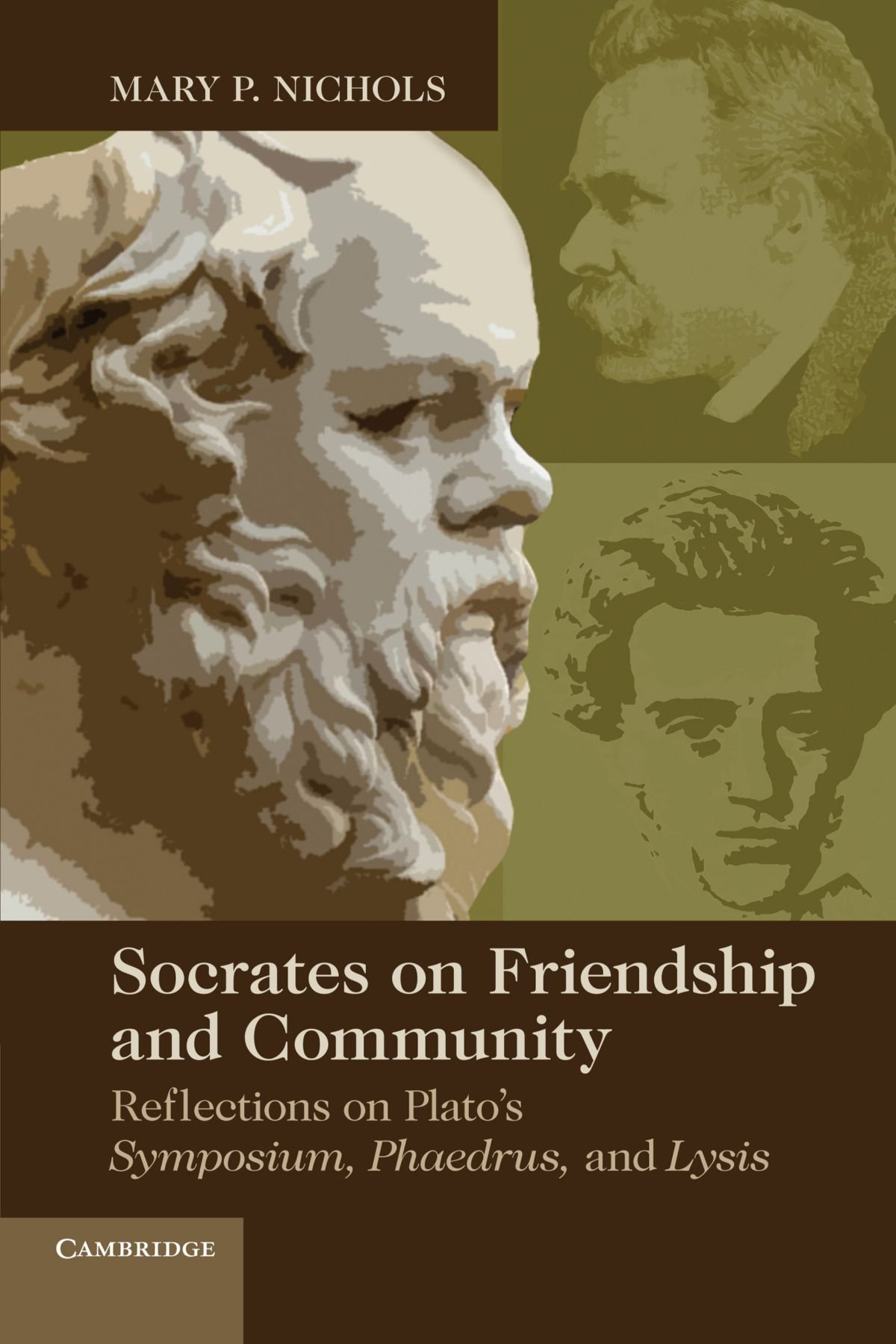
In the modern philosophical tradition, Plato’s Socrates has been viewed as an alienating influence on Western thought and life. In this book, Mary Nichols addresses Kierkegaard’s and Nietzsche’s criticism of Socrates and recovers the place of friendship and community in Socratic philosophizing. Her rich analysis of both dramatic details and philosophic themes in Plato’s Symposium, Phaedras, and Lysis shows how love finds its fulfillment in the reciprocal relation of friends. Nichols shows how friends experience another as their own and themselves as belonging to another. Their experience, she argues, both sheds light on the nature of philosophy and serves as a standard for a political life that does justice to human freedom and community. "Mary Nichols puts together details of the Platonic dialogues in ways that demonstrate the resemblance between Socrates’ desire for a friend and the needs of political communities. She shows convincingly how modern philosophers see only the tendency of Socratic philosophy to dissolve community while underestimating its community-building aspect. Engaging, rich and lucid, her interpretations will have to be considered by anyone who wishes to understand Socrates on love and friendship." -Paul W. Ludwig, St. John’s College, Annapolis "Nichols presents an astute analysis of Plato's understanding of friendship as recognizing unity and diversity as the condition of community. In particular, her close reading of the three dialogues is a valuable contribution to this overarching theme but will also be of interest to scholars and students exploring these dialogues." Canadian Journal of Political Science Marlene K. Sokolon, Concordia University "[Nichol's] argument that these three dialogues form a unified teaching on the importance of friendship and that Socrates is a proponent of friendship, not alienation, is convincing and an important contribution to the literature. She advances a high standard for rhetoric in political life and makes a case for conversational rhetoric that augments similar arguments in the democratic theory literature. Perspectives on Politics, Alexandra Elizabeth Hoerl, Wabash College "Nichols's thoughtful and important book about the essential place of friendship and community in Socratic philosophizing is itself a friendly correction of Nietzsche and Kierkegaard, one that develops their best insights in showing how poetry and piety come together in philosophy...her fine book will yield abundant fruit for years to come." The Review of Politics, Jacob Howland "Socrates on Friendship and Community will be of considerable interests to classicists, philosophers, and political theorists alike. It focuses its reflections on three Platonic dialogues, but in so doing contributes much to the appreciation of the suggestive art of Platonic composition generally." Hermathena Mary P. Nichols addresses Kierkegaard's and Nietzsche's criticism of Socrates and recovers the place of friendship and community in Socratic philosophizing. Mary P. Nichols is Professor of Political Science and Department Chair at Baylor University. She is the author of numerous books and articles in the history of political thought and politics, literature, and film. Her main areas of research are classical political theory (for example Citizens and Statesmen: A Commentary on Aristotle's 'Politics'), Shakespeare, and film directors such as Woody Allen, John Ford, and Alfred Hitchcock. She is a senior Fellow at The Alexander Hamilton Institute for the Study of Western Civilization in Clinton, New York.
| Gtin | 09780521148832 |
| Mpn | Refer To Sapnet. |
| Age_group | ADULT |
| Condition | NEW |
| Gender | UNISEX |
| Product_category | Gl_book |
| Google_product_category | Media > Books |
| Product_type | Books > Subjects > Politics & Social Sciences > Philosophy > History & Schools Of Thought > Western > Ancient Greek & Roman |