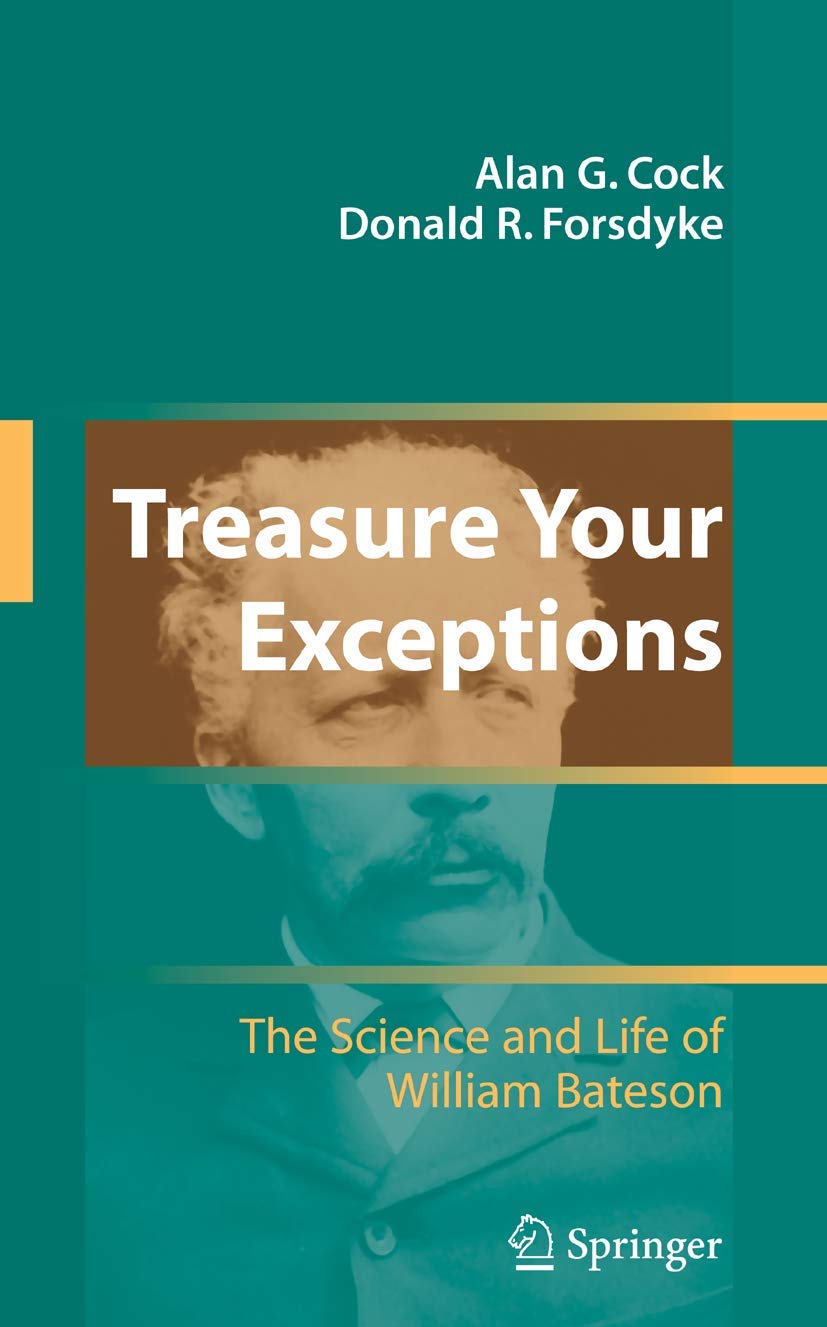
While aware of the works of various evolutionists in their dotage (Galton, Wallace, Weismann), initially Bateson is likely to have overlooked Hugo de Vries’ Intracellular Pangenesis. De Vries modified Darwin’s hypothesis of “pangenesis,” according the “elements,” or “pangens” that corresponded to individual characters, attributes that we now know to be those of genes. Darwin thought a character acquired during an individual’s life time, could, by virtue of the transfer of the corresponding educated pangens (gemmules), be passed on to its children. However, experiments by Galton and Heape d- proved his belief that the pangens could move from normal tissue cells to - nadal cells. Like Weismann, Galton saw the potentially immortal germ-line (stored in the ovary or testis) as distinct from the soma (the mortal remainder of the body). Since gametes remained the same size from generation to g- eration, then each parent could on average only transmit half its elements to a child, the other half being lost. This meant that there might be competition between elements for representation in future generations. “Ancestral” ch- acters that disappeared and later reappeared were due to “latent” (hidden) elements. These were distinguished from the “patent” (overt) elements that determined characters regularly seen in the offspring. Both elements were in the gametes as “primary elements. ” The latent elements constituted a “re- due” that remained after separation of “patent elements” from the primary elements. Galton downplayed the role of Darwin’s natural selection. From the reviews: "This work includes key events in Bateson’s career and is strengthened by discussion of the rediscovery of Mendelian principles by early-20th-century geneticists. … this interesting work will appeal to biologists and historians of science. Summing Up: Recommended. Upper-division undergraduate through professional collections." (J. S. Schwartz, Choice, Vol. 46 (7), March, 2009) "The presnt book is particularly welcome in helping to fill a significant gap in the history of genetics … . Donald Forsdyke has now extended and completed the book, a major undertaking for which both geneticists and historians should be grateful." (Peter S. Harper, Human Genetics, Vol. 125, 2009) "This volume will be of enormous benefit to historians of science who like to follow how ideas are born or die and why participants of different sides of each controversy held such rigid views of their own work and saw little merit in their competitor’s research. … I recommend reading all 745 pages of this biography. It is worth the effort … ." (Elof Axel Carlson, The Quarterly Review of Biology, Vol. 84, December, 2009) “Cock and Forsdyke’s detailed scientific biography of Bateson is very timely. … a fascinating read and well worth the effort. It is a splendid addition to the several good historical works on genetics that have appeared in recent years and also serves as a salutary reminder that great ideas in science have a habit of being successively reborn, often in superficially different forms and guises … . serve as a pragmatic impetus for all scientists to carefully study the history of their respective fields.” (Amitabh Joshi, Journal of Genetics, Vol. 89 (4), December, 2010) William Bateson brought the work of Mendel (and much more) to the attention of the English-speaking world. He commanded the biological sciences in the decades after Darwin's death in 1882. To understand these years we must first understand Bateson. Through examination of the life of a major contributor to the turn-of-the-century revolution in biology, the authors of this volume reconcile the genocentrism of George Williams and Richard Dawkins with the hierarchical thinking of Richard Goldschmidt and Stephen Jay Gould. The anti-Darwinian arguments of Bateson are only now, a century later, gaining recognition. At last, Evolutionists can present a unified front to their creationist opponents.
| Gtin | 09780387756875 |
| Mpn | 9780387756875 |
| Age_group | ADULT |
| Condition | NEW |
| Gender | UNISEX |
| Material | Cellulose-based Or Similar Non-woven Material |
| Product_category | Gl_book |
| Google_product_category | Media > Books |
| Product_type | Books > Subjects > Science & Math > Biological Sciences > Biology |