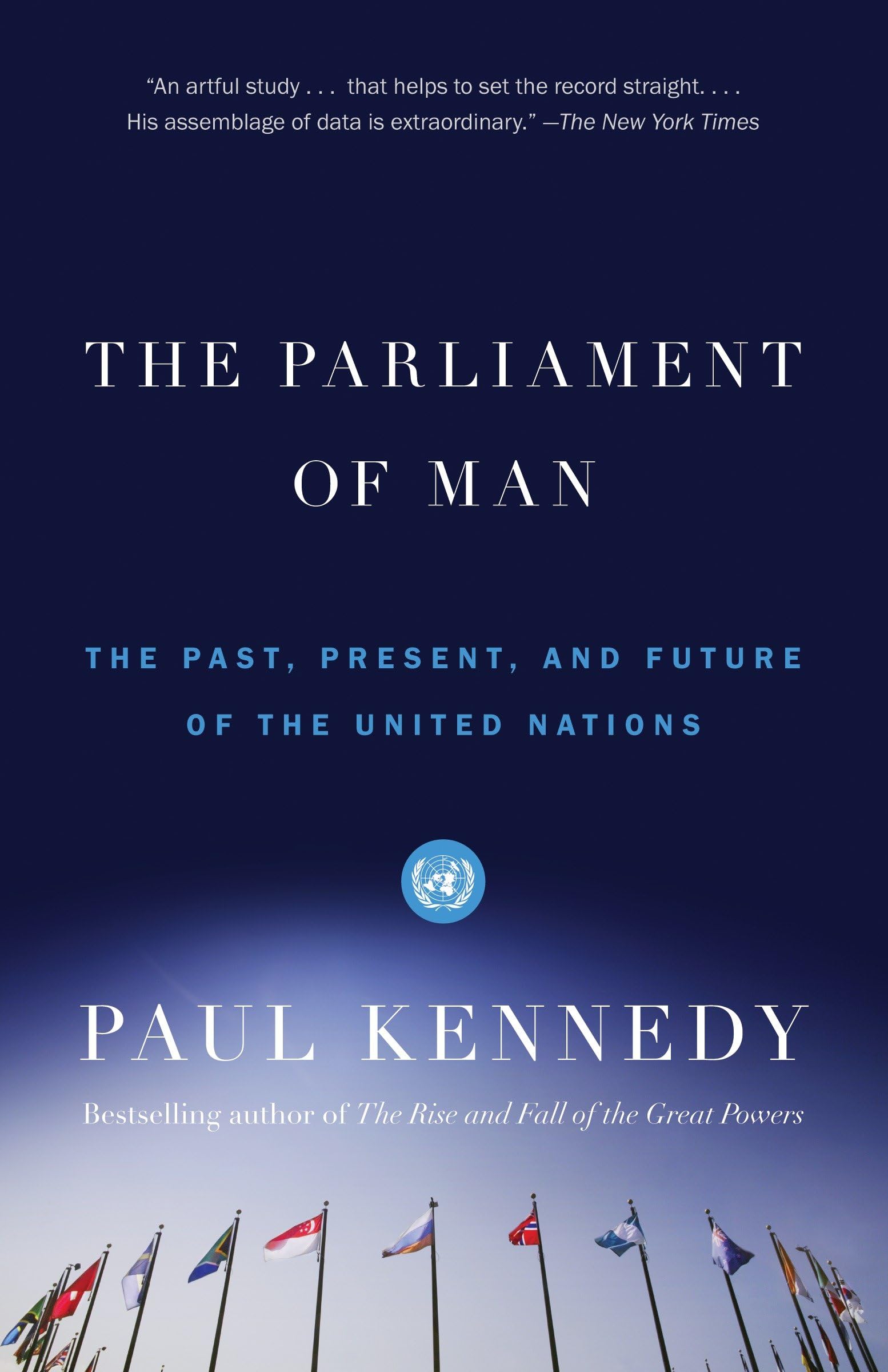
The Parliament of Man is the first definitive history of the United Nations, from one of America's greatest living historians.Distinguished scholar Paul Kennedy, author of the bestselling The Rise and Fall of Great Powers , gives us a thorough and timely account that explains the UN's roots and functions while also casting an objective eye on its effectiveness and its prospects for success in meeting the challenges that lie ahead. Kennedy shows the UN for what it is: fallible, human-based, often dependent on the whims of powerful national governments or the foibles of individual administrators—yet also utterly indispensable. With his insightful grasp of six decades of global history, Kennedy convincingly argues that "it is difficult to imagine how much more riven and ruinous our world of six billion people would be if there had been no UN." "An artful study . . . that helps to set the record straight. . . . His assemblage of data is extraordinary." — The New York Times “Kennedy traces this . . . story with concision, grace, and fairness. Nearly every page contains some delicious morsel . . . reflecting Kennedy’s intelligence and deep knowledge of world affairs.” — San Francisco Chronicle “Amid the morass of commissions and conferences, and failures like Rwanda, he manages to find something convincingly heroic.” — The New Yorker Paul Kennedy is the author or editor of thirteen books, including Preparing for the Twenty-first Century and T he Rise and Fall of the Great Powers , which has been translated into more than twenty languages. He serves on the editorial board of numerous scholarly journals and has written for The New York Times , Los Angeles Times , The Atlantic Monthly , and several other publications. Educated at Newcastle University and Oxford University, he is a former fellow of the Institute for Advanced Studies at Princeton University and of the Alexander von Humboldt-Stiftung in Bonn. Kennedy: THE PALIAMENT OF MAN PART 1 The Origins CHAPTER 1 The Troubled Advance to a New World Order, 1815–1945 The idea of a universal association of humankind goes back hundreds if not thousands of years. Some works claim that ancient Chinese philosophers or Greek sages were arguing even then for the establishment of a world order. Others suggest that Catholic theologians in the Middle Ages proposed some form of universal governance, no doubt Christian in construction but reaching out to all peoples. All sorts of institutional and scholarly names are tossed out here: the federation of Greek city-states, the Stoics, various disciples of Confucius, Dante, William Penn, the Abbé de St.-Pierre with his “Project to Render Peace Perpetual in Europe” (1713), the American founding fathers in their pursuit of a “more perfect union,” and then, perhaps especially, the Prussian philosopher Immanuel Kant’s Perpetual Peace of 1795. The list is long; later, even Lenin wrote in favor of “the United States of Europe,” while H. G. Wells and Arnold Toynbee pleaded for a new international system of affairs.1 It comes as no surprise that most of these texts were composed near the end of, or shortly after, a great and bloody war. They were efforts to find a way out of the international anarchy, to escape the repeated struggles between cities, monarchies, and states, and to establish long-lasting peace. All of them sought to constrain selfish, sover- eign power, usually by some form of league of nations that would take action against a country that broke the existing order. The mechanisms were therefore reactive, assuming humankind’s propensity to conflict but trusting that such dangerous drives could be headed off. They were devices to chain national egoism; as St.-Pierre argued, all members must be placed in a “mutual state of dependence.” From this negative intent there would flow positive benefits: global harmony, rising prosperity, the pursuit of the arts, and so on. To say that this was idealist would be a gross understatement.We might note that Kant’s great treatise was composed just a few years before Napoleon began his rampage across Europe, leaving damaged and raped communities everywhere. Nonetheless, these early writings contained ideas that would not go away. They were ideas, moreover, that formed a central part of the intellectual architecture of the Enlightenment, the rise of the free trade movement, and the advance of Western liberalism. There was, to be sure, no real move toward a universal monarchy in the early nineteenth century, nor toward any parliament of man. Indeed, the only international structure at that time was the rather informal Concert of Europe, run by the five Great Powers, which was usually conservative in hue. However, since each of those powers was reluctant to risk another expensive and potentially destabilizing war, a general peace obtained.2 Despite that conservatism, there also existed an urge toward the more liberal conduct of affairs, especially in Western Eur
| Color | Navy |
| Gtin | 09780375703416 |
| Mpn | 9780375703416 |
| Age_group | ADULT |
| Condition | NEW |
| Gender | UNISEX |
| Product_category | Gl_book |
| Google_product_category | Media > Books |
| Product_type | Books > Subjects > Politics & Social Sciences > Politics & Government > International & World Politics > Diplomacy |