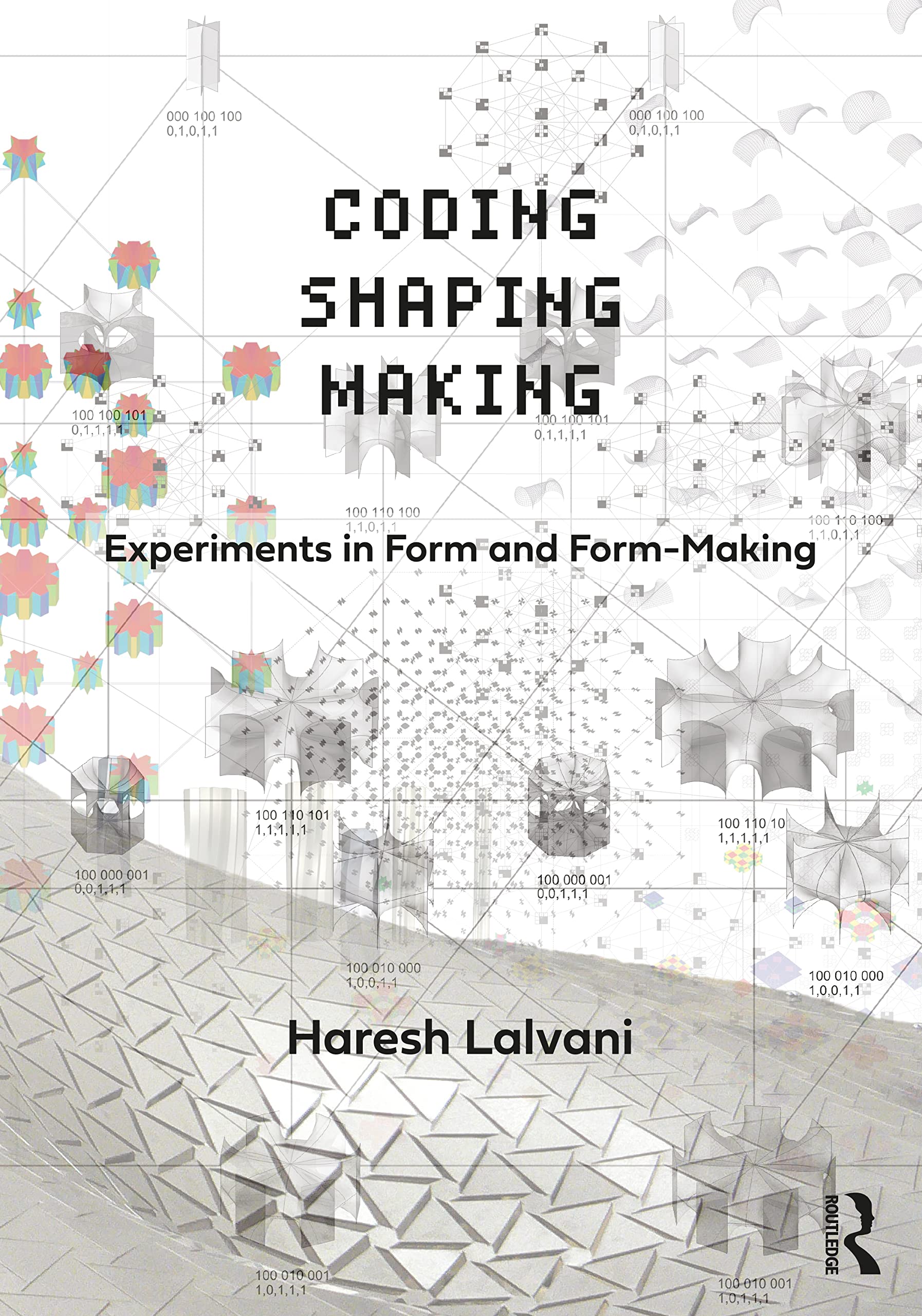
Coding, Shaping, Making combines inspiration from architecture, mathematics, biology, chemistry, physics and computation to look towards the future of architecture, design and art. It presents ongoing experiments in the search for fundamental principles of form and form-making in nature so that we can better inform our own built environment. In the coming decades, matter will become encoded with shape information so that it shapes itself, as happens in biology. Physical objects, shaped by forces as well, will begin to design themselves based on information encoded in matter they are made of. This knowledge will be scaled and trickled up to architecture. Consequently, architecture will begin to design itself and the role of the architect will need redefining. This heavily illustrated book highlights Haresh Lalvani’s efforts towards this speculative future through experiments in form and form-making, including his work in developing a new approach to shape‐coding, exploring higher‐dimensional geometry for designing physical structures and organizing form in higher-dimensional diagrams. Taking an in-depth look at Lalvani’s pioneering experiments of mass customization in industrial products in architecture, combined with his idea of a form continuum, this book argues for the need for integration of coding, shaping and making in future technologies into one seamless process. Drawing together decades of research, this book will be a thought-provoking read for architecture professionals and students, especially those interested in the future of the discipline as it relates to mathematics, science, technology and art. It will also interest those in the latter fields for its broader implications. 'We see in the history of science the laying down of foundational elements before a new paradigm bursts forth. Thus the work of Copernicus, Brahe, Kepler, and Galileo preceded Newtonian mechanics. And the Michelson-Morley measurements, the Lorentz transformations, and Poincaré's mathematics proceeded Einstein's relativity. We are today again in such a moment as a new paradigm is emerging, generative morphogenetics, the unfolding of form from simple rules,,,.Lalvani's Coding, Shaping, Making: Experiments in Form and Form-Making is a foundational work underlying [this] emerging field….As such it joins D’'Arcy Thompson's growth and form, John Archibald Wheeler's it from bit, David Deutsch's constructor theory, Stephen Wolfram's new kind of science, and Neil Gershenfeld's information in the material. To put it simply, Lalvani asks…are there fundamental morphological principles at work that we do not yet fully understand? Lalvani contends that there are, and he explores them. Lalvani's work has implications for important new developments in morphology, mathematics, logic, chemistry, biology, evolutionary theory, nanotechnology, digital fabrication among many other fields. I believe researchers in numerous fields will mine his work for new avenues of understanding for decades to come. Stephen Wolfram says, "I think when I find the code that generates our world, it will be about six lines." Lalvani brings us hints of that code.' - John Lobell, Professor of Architecture, Pratt Institute 'Lalvani’s ground-breaking concept of ‘Morphological Universe’ included in this book….captures the most original aspects of his work in design science. What he has done is amazing. I believe it to be a grand unification of what others have done in small pieces. It is astounding to see it all come together masterfully in a beautifully visual representation which is also theoretically mathematical. I would say that transformation is the key to Lalvani’s approach. Nothing is a single incident… the value of a taxonomy of form such as Lalvani’s Morphological Universe is in its applications which he demonstrates masterfully in both beautiful diagrams as well as his physical experiments with materials. He likens this work to a kind of DNA of form….in which by inputting a code of numbers he is able to call up a wide variety of forms which are then capable of fabrication in physical materials. This is a new way to create both art, and industrial design. …he has carried out experiments in which the surfaces shape themselves under a force…This self-shaping is a new principle of morphogenesis. ….Lalvani continues to integrate yet more material into his system. And it is the very notion of a system behind all of these forms which appears not only in geometry and design but in other fields such as biology, geology, botany and perhaps even particle physics, that is his real contribution through these efforts.' - Jay Kappraff, Emeritus Associate Professor of Mathematics, New Jersey Institute of Technology 'Throughout history, we find a distinguished list of visionaries, seeking to bring clarity and reason to the unknown. The perpetual search for the underlying order that governs our complex universe has captivated our imagination and drawn them
| Gtin | 09780367638795 |
| Age_group | ADULT |
| Condition | NEW |
| Gender | UNISEX |
| Product_category | Gl_book |
| Google_product_category | Media > Books |
| Product_type | Books > Subjects > Engineering & Transportation > Engineering > Reference > Architecture > Methods & Materials |