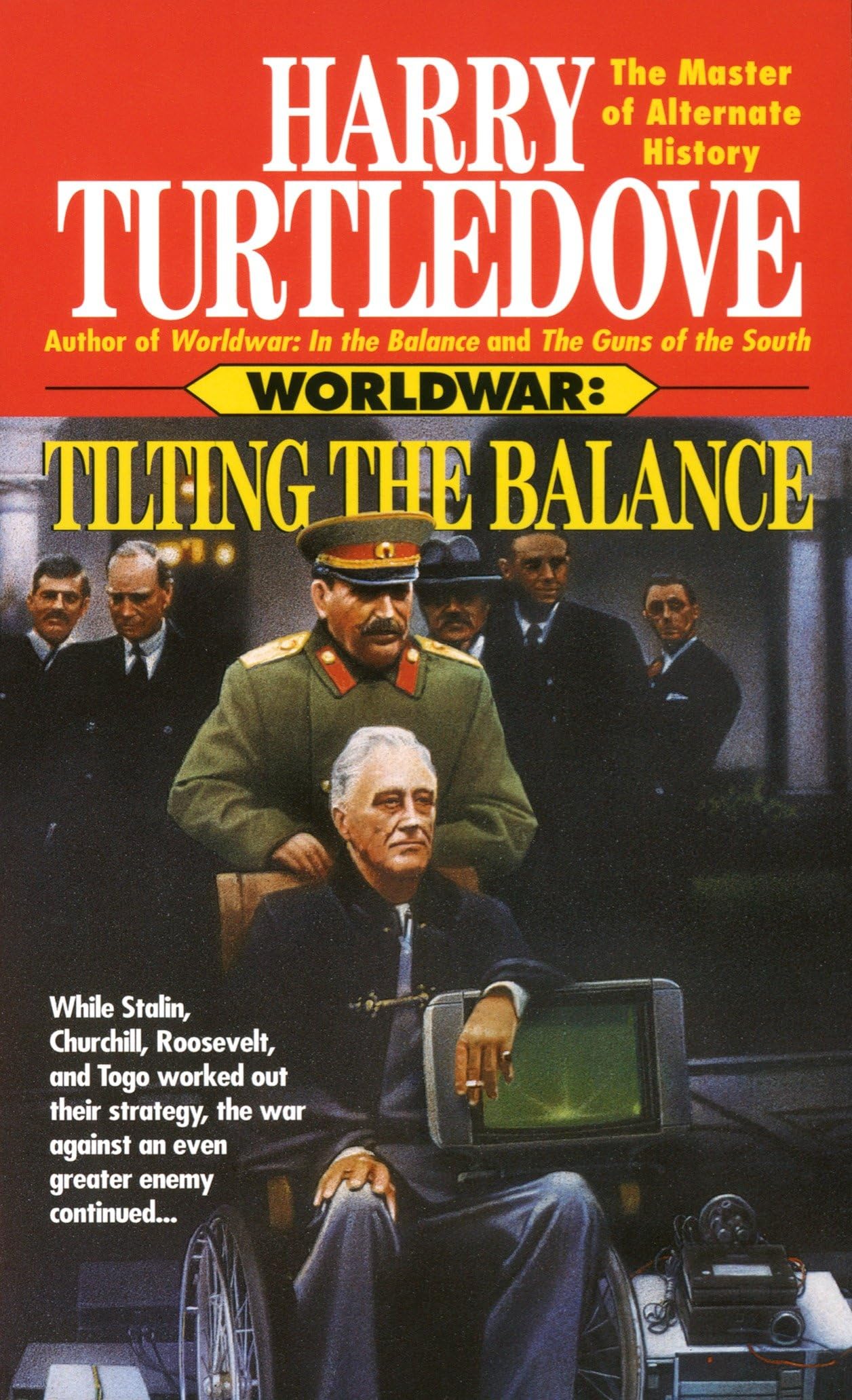
While Stalin, Churchill, Roosevelt, and Togo worked out their strategy, the war against an even greater enemy continued . . . They cut the United States in two. They devastated much of Europe. They had a ferocious agenda. And no one could stop them. World War II screeched to a halt as the Russians, Germans, Americans, and Japanese scrambled to meet an even deadlier foe. In Warsaw, Jews welcomed the invaders as liberators, only to be cruelly disillusioned. In China, the Communist guerrillas used every trick they knew. In America, Washington, D.C., was vaporized in a matter of seconds. But humanity would not give up—whether delivering supplies in tiny biplanes to partisans across the vast steppes of Russia, working furiously to understand the enemy’s captured radar in England, or battling house to house on the streets of Chicago. . . . As Turtledove’s global saga of alternate history continues, humanity grows more resourceful, even as the menace worsens. No one could say when the hellish inferno of death would stop being a war of conquest and turn into a war of survival—a war for the survival of the planet. What got me about the Worldwar series wasn't the aliens. It wasn't the warfare (though Harry's really good at it--I especially love the tanks). It wasn't even the fact that he'd turned history on its ear in a big way. No, it was the people. If they were historical figures, like Josef Stalin, or Adolf Hitler, or Omar Bradley, he really brought them back to life. But even they took a back seat to Harry's original characters--the soldiers, the civilians, the resistance members, the spies. Whether they were American or Russian or British or Chinese, he made me care about them, about their lives and their loves. And he made me care a lot about their deaths--the kind of deaths that happen in war. He made the most out of cultural juxtaposition, when a Polish Jew had to fight alongside a Nazi, or a British officer found himself in a tumultuous affair with a female Russian pilot (and sharpshooter--whoosh). These were the real people, They took a science fiction alternate history and elevated it to a new level. The result is a terrific adventure. --Steve Saffel, Senior Editor NO ONE COULD STOP THEM-- NOT STALIN, NOT TOGO, NOT CHURCHILL, NOT ROOSEVELT . . . The invaders had cut the United States virtually in half at the Mississippi, vaporized Washington, D.C., devastated much of Europe, and held large parts of the Soviet Union under their thumb. But humanity would not give up so easily. The new world allies were ruthless at finding their foe's weaknesses and exploiting them. Whether delivering supplies in tiny biplanes to partisans across the vast steppes of Russia, working furiously to understand the enemy's captured radar in England, or battling house to house on the streets of Chicago, humankind would never give up. Yet no one could say when the hellish inferno of death would stop being a war of conquest and turn into a war of survival--the very survival of the planet . . . NO ONE COULD STOP THEM-- NOT STALIN, NOT TOGO, NOT CHURCHILL, NOT ROOSEVELT . . . The invaders had cut the United States virtually in half at the Mississippi, vaporized Washington, D.C., devastated much of Europe, and held large parts of the Soviet Union under their thumb. But humanity would not give up so easily. The new world allies were ruthless at finding their foe's weaknesses and exploiting them. Whether delivering supplies in tiny biplanes to partisans across the vast steppes of Russia, working furiously to understand the enemy's captured radar in England, or battling house to house on the streets of Chicago, humankind would never give up. Yet no one could say when the hellish inferno of death would stop being a war of conquest and turn into a war of survival--the very survival of the planet . . . Harry Turtledove is the award-winning author of the alternate-history works The Man with the Iron Heart, The Guns of the South, and How Few Remain (winner of the Sidewise Award for Best Novel); the Hot War books: Bombs Away, Fallout, and Armistice; the War That Came Early novels: Hitler’s War, West and East, The Big Switch, Coup d’Etat, Two Fronts, and Last Orders; the Worldwar saga: In the Balance, Tilting the Balance, Upsetting the Balance, and Striking the Balance; the Colonization books: Second Contact, Down to Earth, and Aftershocks; the Great War epics: American Front, Walk in Hell, and Breakthroughs; the American Empire novels: Blood and Iron, The Center Cannot Hold, and Victorious Opposition; and the Settling Accounts series: Return Engagement, Drive to the East, The Grapple, and In at the Death . Turtledove is married to fellow novelist Laura Frankos. They have three daughters—Alison, Rachel, and Rebecca—and two granddaughters, Cordelia Turtledove Katayanagi and Phoebe Quinn Turtledove Katayanagi. I For nostalgia’s sake, Fleetlord Atvar called up the hologram of the Tosevite warrior
| Color | Black |
| Gtin | 09780345389985 |
| Mpn | 9780345389985 |
| Age_group | ADULT |
| Condition | NEW |
| Gender | UNISEX |
| Product_category | Gl_book |
| Google_product_category | Media > Books |
| Product_type | Books > Subjects > Literature & Fiction > Genre Fiction > War |