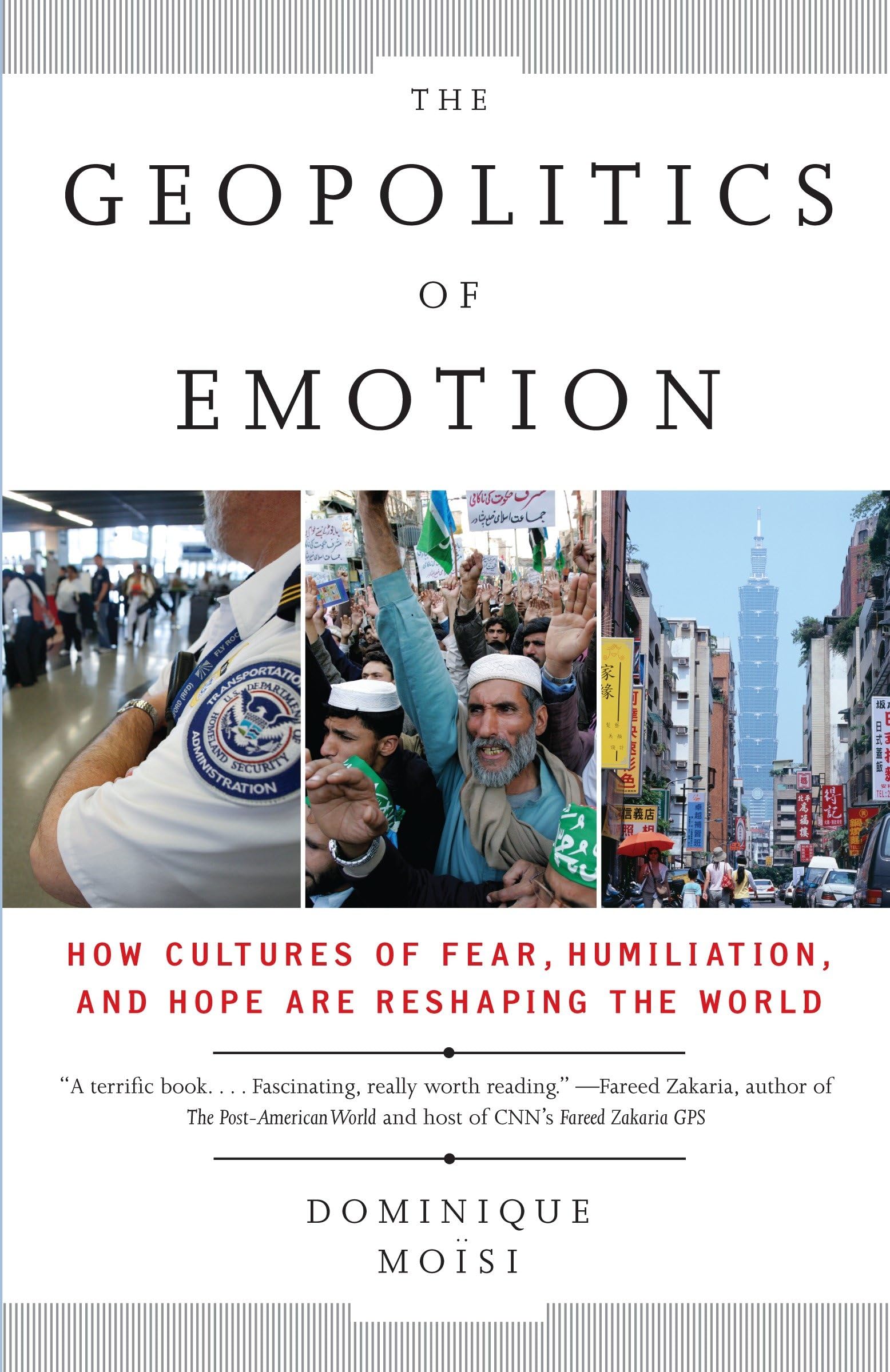
In the first book to investigate the far-reaching emotional impact of globalization, Dominique Moïsi shows how the geopolitics of today is characterized by a “clash of emotions.” The West, he argues, is dominated and divided by fear. For Muslims and Arabs, a culture of humiliation is quickly devolving into a culture of hatred. Asia, on the other hand, has been able to concentrate on building a better future, so it is creating a new culture of hope. Moïsi, a leading authority on international affairs, explains that in order to understand our changing world, we need to confront emotion. And as he makes his case, he deciphers the driving emotions behind our cultural differences, delineating a provocative and important new perspective on globalization. “A terrific book. . . . Fascinating, really worth reading.” —Fareed Zakaria, author of The Post-American World and host of CNN’s Fareed Zakaria GPS “Rich in intelligence and insight. . . . Today’s reflex is to strive for simplicity. Dominique Moïsi performs the infinitely more valuable task of making sense of the cacophony of complexities that shape our world.” — Financial Times “Groundbreaking. . . . An astonishingly creative response to Samuel Huntington’s The Clash of Civilizations .” — Publishers Weekly (starred review) “Compassionate. . . . A clear-sighted plea for understanding ‘the Other’ in the age of globalisation.” — The Observer (London) “This is Moisi at his best: original, challenging and full of elegance. This little book shows how globalization has forged a new world disorder defined as much by clashes of emotions, as divisions over interests and power.” —Mark Leonard, author of What Does China Think? “Human beings are not automata concerned solely with maximising wealth or power. They are bundles of emotions. In this scintillating essay, the French analyst, Dominique Moisi, explores the role of three potent emotions—hope, humiliation and fear—in shaping the world we live in today and might live in tomorrow.” —Martin Wolf, author of Fixing Global Finance Dominique Moïsi is a founder of and now a senior adviser to the French Institute of International Affairs (IFRI) in Paris. He writes a column for the Financial Times and contributes to Foreign Affairs . In spring 2009 Moïsi was a visiting professor in the Department of Government, and the Pierre Keller Visiting Professor at the Weatherhead Center for International Affairs, at Harvard University. He is a Professor of International Relations at the College of Europe in Natolin (Warsaw). Chapter One Globalization, Identity, and Emotions In an age of globalization, emotions have become indispensable to grasp the complexity of the world we live in. Magnified by media, they both reflect and react to globalization and in turn influence geopolitics. Globalization may have made the world "flat," to cite journalist Thomas Friedman's famous metaphor, but it has also made the world more passionate than ever. In a moment, we shall examine the reasons that this is true. But first we need to clarify the nature of globalization itself, since many people misunderstand it. In his book The Lexus and the Olive Tree, Friedman defines globalization as the international system that replaced that of the Cold War. Unlike the Cold War system, globalization is not static but a dynamic ongoing process, involving the inexorable integration of markets, nation--states, and technologies to a degree never before witnessed, in a way that is enabling individuals, corporations, and countries to reach around the world farther, faster, deeper, and cheaper than ever before. This same process is also producing a powerful backlash from those brutalized or left behind by the new system. For many people, especially critics, globalization is identical with Americanization. The spread of American influence--political, economic, and cultural--dates back at least to the Second World War, but it gained new strength after the end of the Soviet empire in 1991, which left the United States as the world's only superpower. Thus the growing unification of the world's economies and cultures means in effect a unification on American terms. As a result, today's antiglobalization protests, which are now mounting with the deepening of the current financial and economic crisis, combine anti--American sentiments with anticapitalist critiques in their struggle for equality, fair trade, and sustainable development. But when we look closer, we see that the equation of globalization with Americanization is too simplistic. The reality is that while the cultural influence of the United States throughout the world is all--pervasive and unprecedented, economically the West is being overtaken by Asia. The current phase of globalization reflects the coming-of-age of the Asian continent, resulting in the relay of economic power from an American--dominated West to China and India. Globalization can thus be seen as the combination of two disparate
| Color | White |
| Gtin | 09780307387370 |
| Mpn | 9780307387370 |
| Age_group | ADULT |
| Condition | NEW |
| Gender | UNISEX |
| Product_category | Gl_book |
| Google_product_category | Media > Books |
| Product_type | Books > Subjects > Politics & Social Sciences > Politics & Government > Specific Topics > Globalization |

