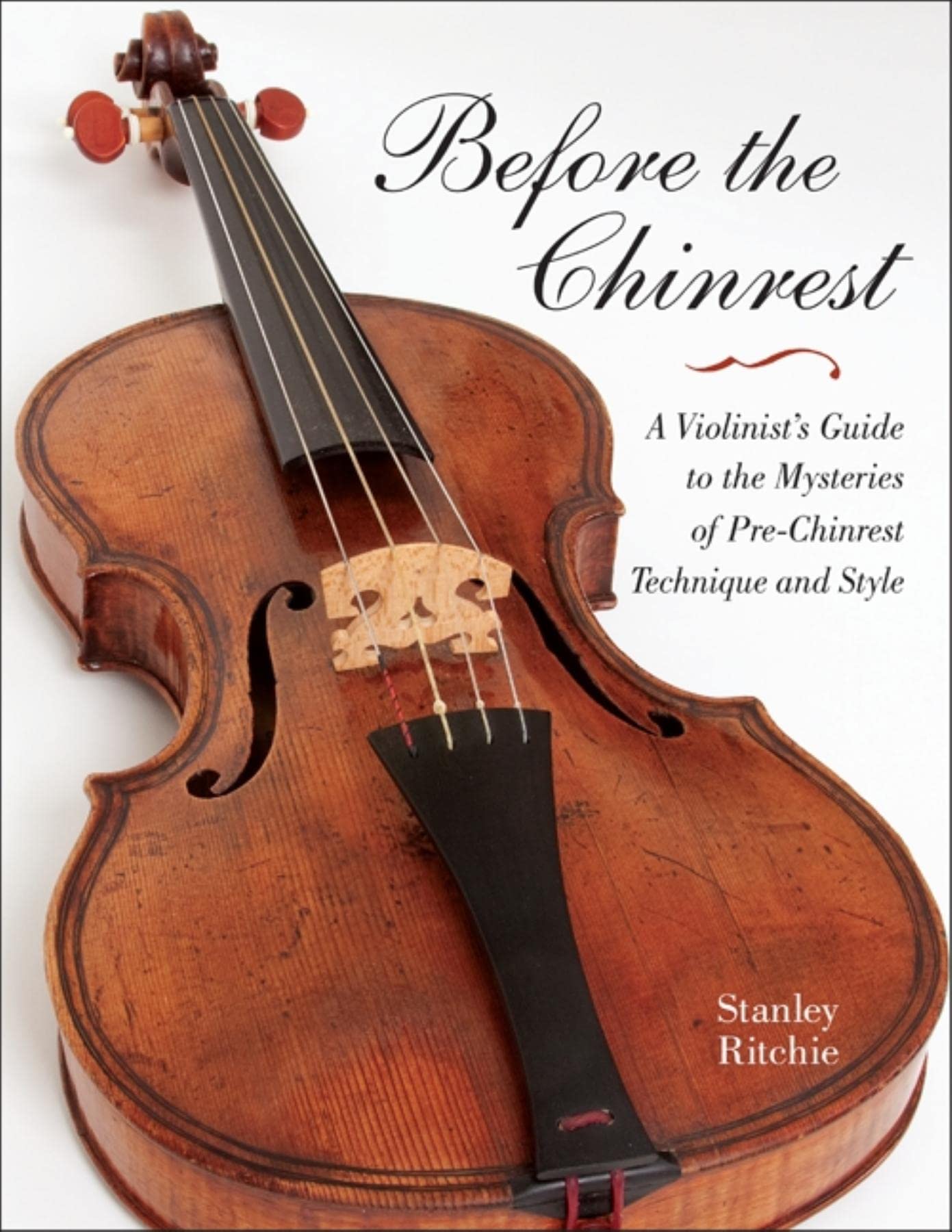
Drawing on the principles of Francesco Geminiani and four decades of experience as a baroque and classical violinist, Stanley Ritchie offers a valuable resource for anyone wishing to learn about 17th-18th-and early 19th-century violin technique and style. While much of the work focuses on the technical aspects of playing the pre-chinrest violin, these approaches are also applicable to the viola, and in many ways to the modern violin. Before the Chinrest includes illustrated sections on right- and left-hand technique, aspects of interpretation during the Baroque, Classical, and early-Romantic eras, and a section on developing proper intonation. "' Before the Chinrest ' is aimed at modern violinists and viola players who are 'curious to learn about technique and style as understood and practised by their seventeenth and eighteenth-century predecessors', so it is designed as a practical guide and includes a wealth of information, musical examples and technical exercises Ritchie divides the book into four sections: right-hand technique, left-hand technique, interpretation, and a technique and intonation practice guide. I found myself in agreement with a great number of his points about matters technical and interpretative, and many of his technical exercises would be extremely helpful to those new to period playing."― Classical Music , Dec 2012 "Useful and elegantly written, Stanley Ritchie's book will be a most valuable resource to accomplished modern violinists wishing to learn to play the baroque violin."―Marc Destrubé, violinist "Professor Stanley Ritchie shares his extensive experience distilled from 40 years of performing and teaching early violin, adding his thorough knowledge of historical sources on 17th and 18th century performance practice. He writes in an elegant, easy to follow style, using terms which a modern violinist can easily relate to. . . . . The book is practically based and best read with a violin in hand―in fact the last section, which amounts to one third of the book, consists of an extensive exercise system for left hand intonation and technique. Here is an exceptionally useful resource for all violinists."― Stringendo "Violinists will . . . find in this book much that is useful and valuable, since it is drawn from Ritchie's many years of experience playing and teaching the instrument."― Early Music America "[Ritchie's] book is accessible and authoritative, and moves what was once specialist information into the mainstream. Moreover, he may just inspire us to spice our music-making with the kind of informed variety and contextual fidelity that would do justice to one of history's most diverse and fecund periods of invention."― Early Music "Before the Chinrest includes many thoughtful suggestions on both technique and musical expression, and its numerous musical exercises . . . will no doubt greatly assist violinists seeking to perform the Baroque and Classical repertoire in a stylistically appropriate manner."― Performance Practice Review Stanley Ritchie is an internationally recognized violinist, teacher, and recording artist. He is a professor at the Jacobs School of Music at Indiana University Bloomington and the 2009 recipient of the Howard Mayer Brown Award for Lifetime Achievement in the Field of Early Music. Before the Chinrest A Violinist's Guide to the Mysteries of Pre-Chinrest Technique and Style By Stanley Ritchie Indiana University Press Copyright © 2012 Stanley Ritchie All rights reserved. ISBN: 978-0-253-22318-0 Contents Preface and Acknowledgments, Introduction: How to Support the Pre-Chinrest Violin, Part 1. Right-Hand Technique, 1. Tone Production, 2. Bow-Strokes, 3. Chordal Technique, 4. Bow Division, 5. Swift-Bows, 6. Combination Strokes, Part 2. Left-Hand Technique, 7. Position-Changing Exercises, Part 3. Interpretation, 8. Expression, 9. Dynamics and Nuance, 10. Tempo, 11. Ornamentation, 12. Baroque Clichés, Part 4. A Technique and Intonation Practice Guide, 13. Tuning, 14. Exercises Starting with the First Finger, 15. Exercises Starting on G, 16. Half-Position, Notes, Index, CHAPTER 1 Tone Production Basic Right-Hand Technique Two words that should never, in my opinion, be used to refer to the contact between hand and bow are "hold" and "grip," as both suggest some kind of effort. Ideally, in my view, one should balance the bow in the hand as lightly as possible, exerting no physical effort. The following are exercises I prescribe to convey this concept: Preliminary exercise: Play a down-bow on the G or D string, and lift the fingers one by one from the stick (4–3–2–1) until only the thumb remains in contact with the bow. It is essential to keep the bow moving in this exercise, which is designed to demonstrate that tone can be produced with only the weight of the bow and the motion of the hair. [ Hint: Allow the hair to rest against the outside of the thumb. ] Then, touching the bow as lightly as
| Gtin | 09780253223180 |
| Mpn | 260 Music Exx. And 1 B&w Illustration |
| Age_group | ADULT |
| Condition | NEW |
| Gender | UNISEX |
| Product_category | Gl_book |
| Google_product_category | Media > Books |
| Product_type | Books > Subjects > Arts & Photography > Music > Instruments > Strings > Violins |

