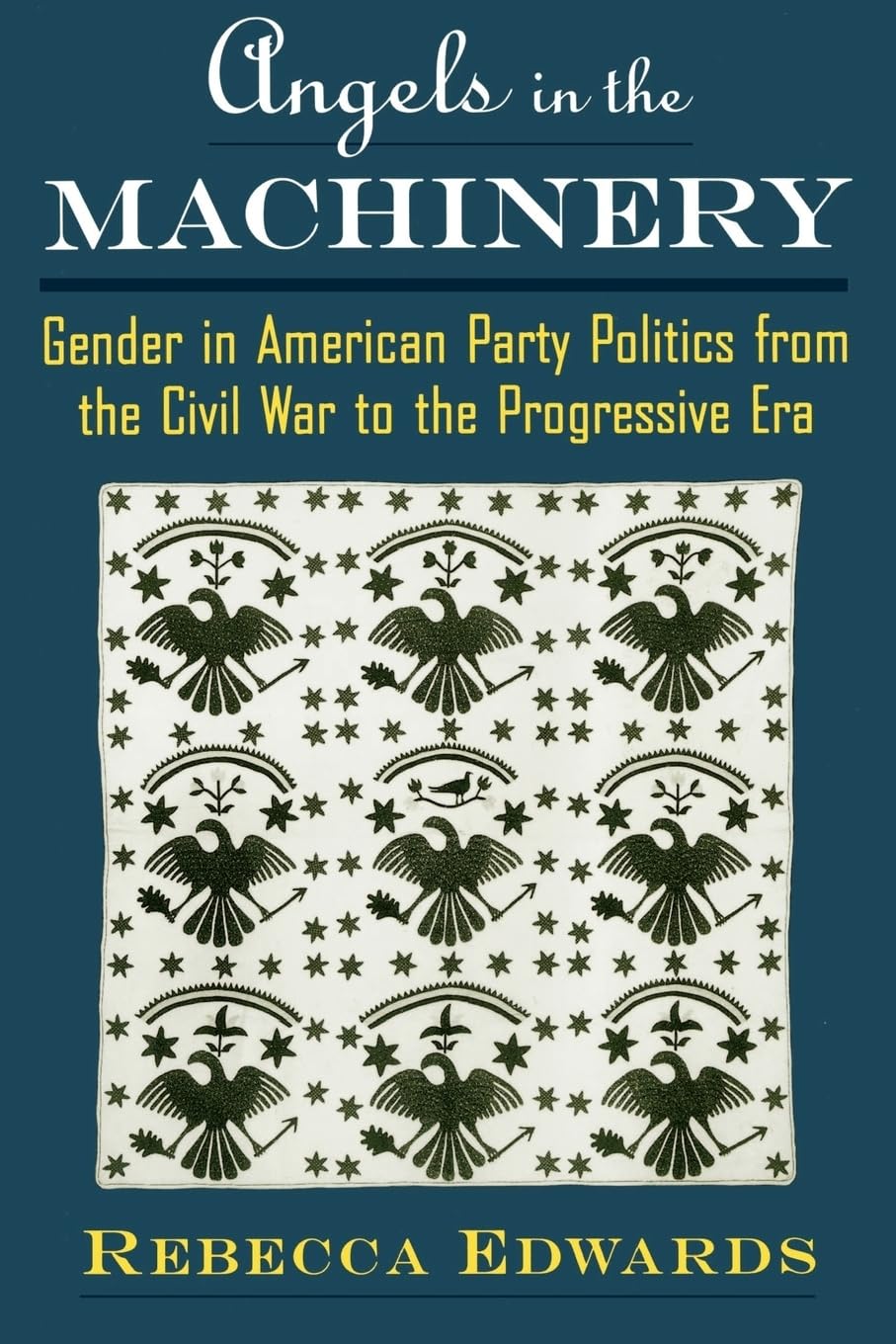
Angels in the Machinery offers a sweeping analysis of the centrality of gender to politics in the United States from the days of the Whigs to the early twentieth century. Author Rebecca Edwards shows that women in the U.S. participated actively and influentially as Republicans, Democrats, and leaders of third-party movements like Prohibitionism and Populism--decades before they won the right to vote--and in the process managed to transform forever the ideology of American party politics. Using cartoons, speeches, party platforms, news accounts, and campaign memorabilia, she offers a compelling explanation of why family values, women's political activities, and even candidates' sex lives remain hot-button issues in politics to this day. "[An] extraordinary achievement....In clear and concise prose, Edwards has transformed the historiographical landscape of nineteenth-century American politics."-- Reviews in American History "A stunning entry in the historical scholarship currently revisioning the politics of the Gilded Age from a gendered perspective....Worthy of serious attention by specialists in both political history and women's history."-- Journal of American History "Important because of its implications for women's studies, politics, and numerous reform movements (including women's suffrage)."-- CHOICE I wrote Angels (originally my U.Va. dissertation) to explore the connection between "family values" arguments and the drive to slash the federal government's size and power. The idea that families and government are engaged in a zero sum game--stronger government means weaker families, and vice versa--has been deeply entrenched in American politics since at least the Civil War era. Once I started delving I found a rich body of information on women's partisan activism in the 1880s and 1890s, as well as on the gender dimensions of political debate. Angels thus proceeds on multiple tracks: it recounts women's role in party politics during the Gilded Age; it analyzes the ways men and women deployed gender ideals to advance their causes; and it considers the relationship between the two. One of historians' most important jobs is to tell a good story. For general readers I have tried to tell an entertaining and dramatic tale of vicious attacks, clever ripostes, bitter defeats and slim victories. The Democrat who said his opponent would be "of no more use in Congress than a eunuch in a harem," along with Republicans' claims that Populist women were "gallumphing over the frightened face of nature," should make for lively reading. Such quotes also reveal that American politicians have always hit below the belt--a bit reassuring these days when I turn on the TV news. I wrote the book for general audiences and especially for women. The women's movement is in flux and women seem divided in their political loyalties; again, Angels offers some comfort by showing that such has been the case for a long time. I hope the book gives insight into the reasons for such divisions, and ithe troubled relationship between political parties and the movement for women's rights. A gracious friend wrote to me that she enjoyed the book and though she "admits to not having one drop of women's lib," she found herself "rather proud of my gender and their early accomplishments." If the book helps even a few women--activist or not--think about where we stand politically, today, I'll feel it has accomplished much. Rebecca Edwards is Assistant Professor of History at Vassar College.
| Gtin | 09780195116960 |
| Mpn | 8 Pp Halftones |
| Age_group | ADULT |
| Condition | NEW |
| Gender | UNISEX |
| Product_category | Gl_book |
| Google_product_category | Media > Books |
| Product_type | Books > Subjects > Politics & Social Sciences > Social Sciences > Gender Studies > General |