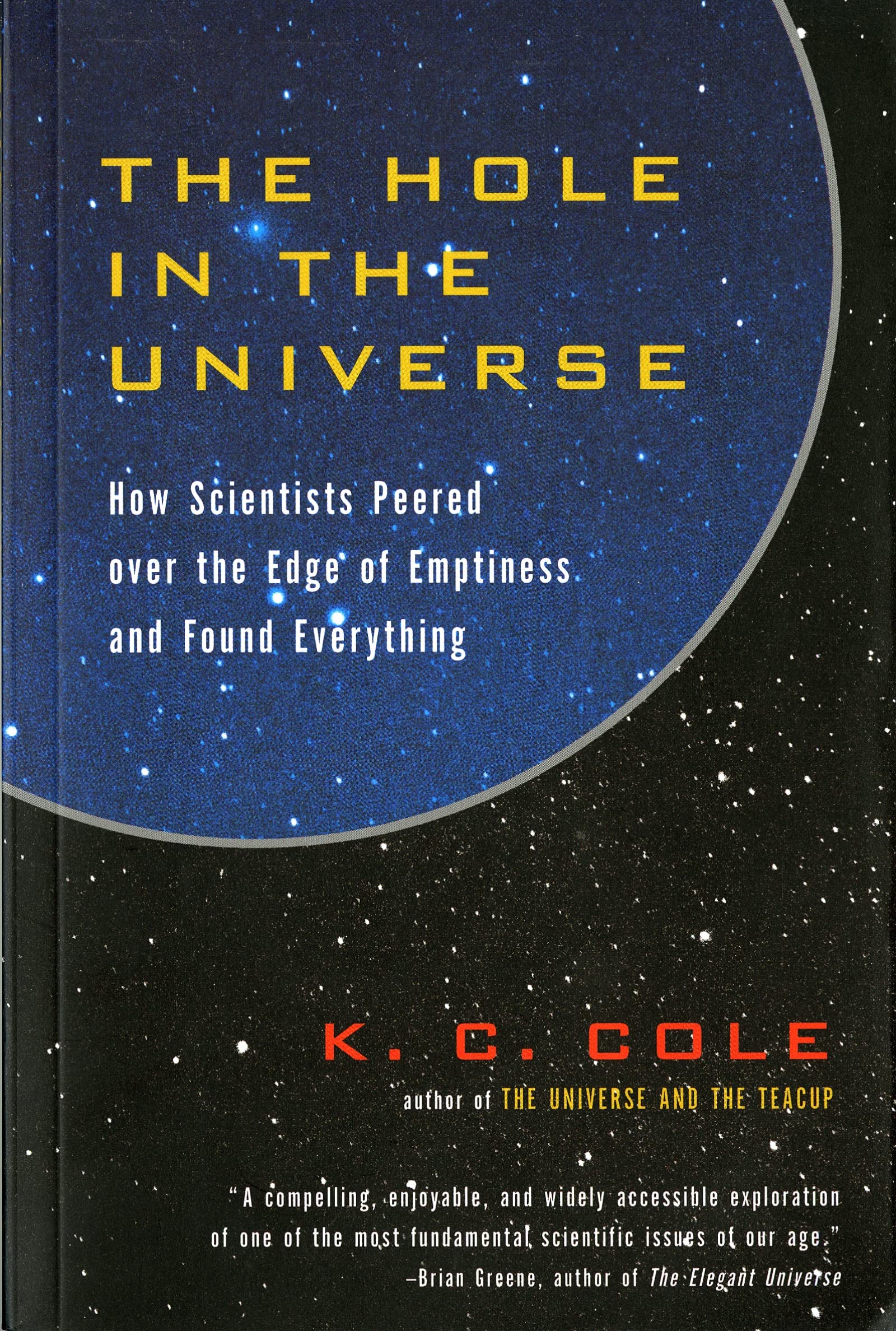
An adventure into the heart of Nothing by best-selling author K. C. Cole. Once again, acclaimed science writer K. C. Cole brings the arcane and academic down to the level of armchair scientists in The Hole in the Universe , an entertaining and edifying search for nothing at all. Open the newspaper on any given day and you will read of a newly discovered planet, star, and so on. Yet scientists and mathematicians have spent generations searching the far reaches of the universe for that one elusive state—nothingness. Although this may sound like a simple task, every time the absolute void appears within reach, something new is discovered in its place: a black hole, an undulating string, an additional dimension of space or time—even another universe. A fascinating and literary tour de force, The Hole in the Universe is a virtual romp into the unknown that you never knew wasn't there. PRAISE FOR THE HOLE IN THE UNIVERSE As clear and accessible as Hawking's A Brief History of Time, this work deserves wide circulation, not just among science buffs." -Publishers Weekly (starred review) Cole has plenty of experience making the most abstruse theories intelligible to the lay reader. . . . A clever and readable investigation."-New York Post A popular science columnist for the Los Angeles Times and teacher at UCLA, K.C. Cole is a recipient of the 1995 American Institute of Physics Award for Best Science Writing. She is also the author of the internationally bestselling The Universe and the Teacup, First You Build a Cloud, and The Hole in the Universe. Cole lives in Santa Monica, California. The Hole in the Universe How Scientists Peered Over the Edge of Emptiness and Found Everything By K. C. Cole Houghton Mifflin Harcourt Publishing Company Copyright © 2001 K.C. Cole All rights reserved. ISBN: 978-0-15-601317-8 CHAPTER 1 WHY NOT? A PRELUDE Nothing is too wonderful to be true. — Michael Faraday There is a hole in the universe. It is not like a hole in a wall where a mouse slips through, solid and crisp and leading from somewhere to someplace. It is rather like a hole in the heart, an amorphous and edgeless void. It is a heartfelt absence, a blank space where something is missing, a large and obvious blind spot in our understanding of the universe. That missing something, strange to say, is a grasp of nothing itself. Understanding nothing matters, because nothing is the all important background upon which everything else happens. Without it, the universe is theater without a stage. Without getting to know it, we can't understand the blank page on which the story of everything is written. We can't trust our own perceptions because everything we see passes through it like a clear but distorting lens, like light from the sky skidding over hot pavement to create a shimmering mirage. For centuries, scientists, mathematicians, and philosophers have tried to track nothing down, give it a name, put a box around it. They've dressed it up with all kinds of decorative effects, like those daisy decals old folks in Florida stick on their sliding glass doors, the better to see the invisible, to avoid bumping their heads. But nothing continues to fool them. Wherever they go, they bump up against it. Today, nothing is back with a vengeance, at the forefront of everything. It is the font of all creation — a hyperactive busybody that expands, explodes, spawns, wiggles, stretches, curls, twirls, pops, burrows, shakes things up, and generally interferes with everything. And yet, it remains as elusive as ever, the chameleon at the center of the cosmos. How can such a powerful presence remain so effectively masked? And how can nothing have such profound effects? To imagine how it might happen, consider a very ordinary kind of "nothing" — like a blank piece of paper. When you write or draw on this featureless background, you're free to create anything you like. From scratch. Ex nihilo. A perfectly featureless background like a blank piece of paper couldn't possibly affect what we draw on it. Or so we like to think. But what if ... The paper is bumpy so that any mark you draw on it skips and sputters from place to place, and you find that it's impossible to draw a perfectly smooth line. Or the paper is slippery, so that your pen slides and the ink oozes off the edge. Or the paper is curled into a cylinder, so that even a straight line circles around and meets itself from the rear. Or the paper is black — so anything you draw on it disappears. Or the paper is three-dimensional, like a cardboard box: suddenly you have many more possibilities for what you can create. Or the paper is one-dimensional, like a line: your possibilities are constricted. Or the paper has zero dimensions, or ten, and they are knotted and twisted in bizarre ways. Or the paper wiggles and waves as you try to write on it. It won't stand still. Or the paper has a barely perceivable background, an intricate set of images that you couldn't see
| Gtin | 09780156013178 |
| Mpn | Illustrated |
| Age_group | ADULT |
| Condition | NEW |
| Gender | UNISEX |
| Product_category | Gl_book |
| Google_product_category | Media > Books |
| Product_type | Books > Subjects > Science & Math > Astronomy & Space Science > Astronomy |

