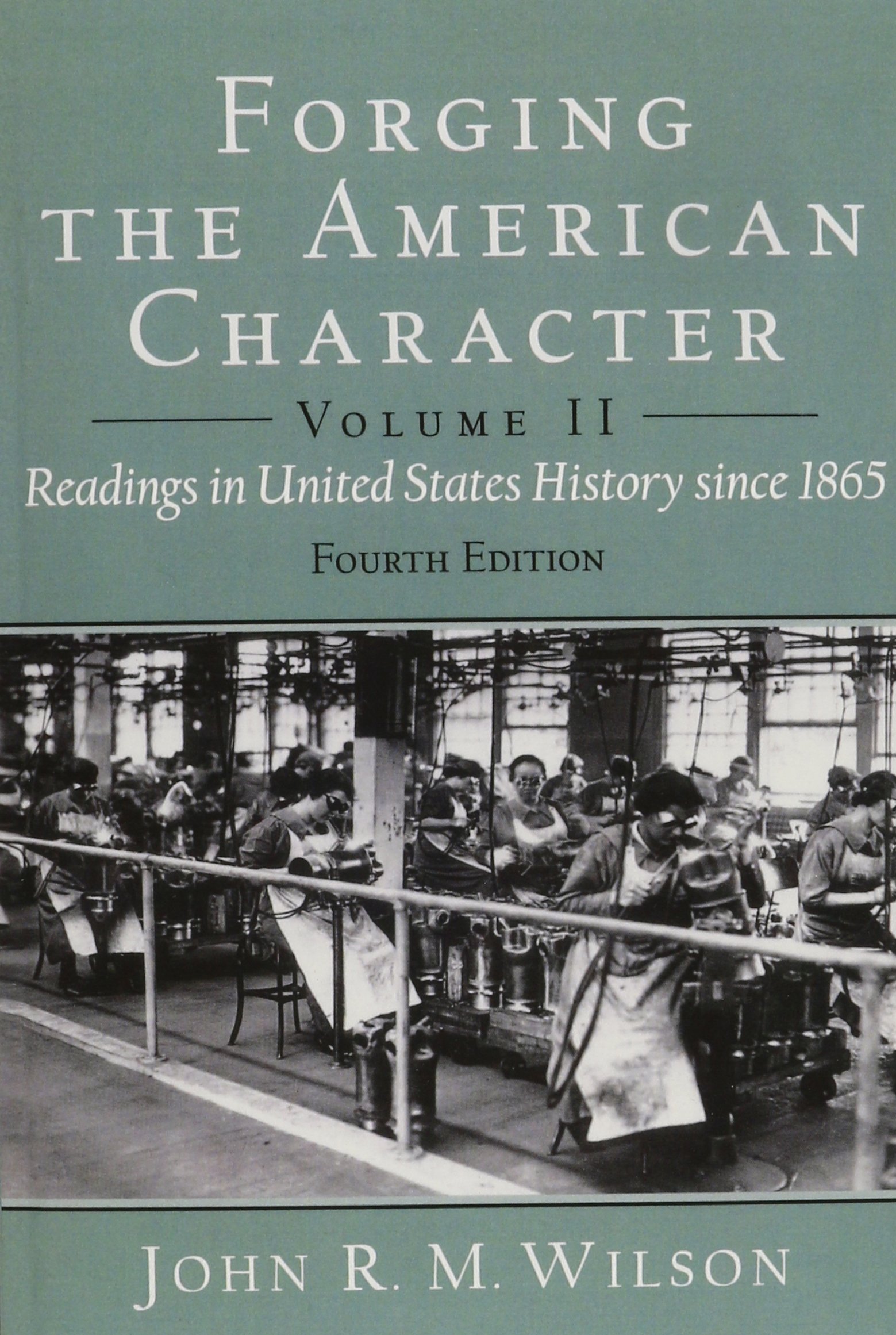
Broad and balanced in perspective—and reader-friendly in format and design—this collection of authoritative readings focuses on the various forces, ideologies, people, and experiences that have forged the distinctive American character. Drawn from an extensive and impressive variety of historical sources—including popular history journals, chapters from key books, and scholarly journals—coverage ranges from traditional fields such as historiography and political, cultural, diplomatic, and religious history, to the new social and women's history. This collection of diverse readings focuses on some of the forces, ideologies, people, and experiences that have helped forge today's distinctive American character. Editor John R. M. Wilson presents the concept of national character as consisting of useful generalizations that elucidate the ways in which a nation or nationality is unique. National character can help explain the tendency of people living in one nation to behave and believe in certain ways that differ from people in other nations. This collection suggests that Americans have defined themselves not only by what they are, but also by what they are not. This negative componentfor example, Americans are anti-communistis an important part of the American character. Volume II: This anthology enables readers to explore various subjects such as the debate over multiculturalism in the 1990s, the mythology of the American cowboy, and various other topics not generally treated in depth in history textbooks. The selections include both classic treatments by giants in the historical profession and new interpretations and findings by young scholars in various sub-fields of history. All explore topics that shed light on the American character. Selections include: Eric Foner, "The New View of Reconstruction" - Catherine McNicol Stock. "Rural Radicals" - Barbara Tuchman, "The First Anti-Imperialists" - William Leuchtenburg, "The Achievement of the New Deal" - Sara Evans, "Cracks in the Mold" - Stephen B. Oates, "Trumpet of Conscience" - John Steele Gordon, "The American Environment" A long United States history textbook may run to 1000 pages. Although that length may seem intimidating to students, it still does not allow extended treatment of a wide variety of fascinating topics. A book of readings, however, does. The theme of this reader is the American character. I trust that the concept will illuminate American history without being overly restrictive. A reader like this one enables students to explore subjects ranging from the influence of Indians and the Spanish on the American experience to the debate over multiculturalism at the turn of the new millennium, from the horrors of life and death in the Civil War to the myths that grew up around the Vietnam War. The nature of the selections varies. Some offer cutting-edge interpretations of the past; others introduce readers to new findings; a few synthesize the writings in a historical subfield; and several are classic statements of enduring value. The readings do not pretend to cover every possible topic; rather, they explore various areas that shed light on the American character yet suffer comparative neglect in many textbooks. Trying to define the American character can be very frustrating. No one has been able to develop a widely accepted definition of the concept. Authors often use different meanings in the same piece of writingfor instance, referring interchangeably to the character of the individual American and to the character of the mass of Americans. National character, especially in a country as big and heterogeneous as the United States, can be useful only as a large-scale generalization to cover the most prominent characteristics of the national culture. Some scholars have criticized efforts to capture the national character, suggesting that in many cases they may merely be intellectually sophisticated forms of racial stereotyping. Yet the practice persists, perhaps because it is so convenient to group people and thus make them more manageable. Perhaps the most useful definition is that national character means generalizations about a nation or nationality developed to clarify the ways in which it is distinctive. A national character suggests tendencies on the part of a people, not fixed positions held by everyone. It means that, all things being equal, the people of a given nation are more likely to believe or behave in a certain way than those of another nation. There is an inherent comparison implied in suggesting a national character, although studies of the American character generally tend not to explicitly explore other nationalities. The genre began very early in the history of the United States with the publication in 1782 of J. Hector St. John de Crevecouer's Letters from an American Farmer; the immigrant asked the famous question, "What then is this American, this new man?" Crevecouer's pioneering inquiry into the America
| Gtin | 09780130977663 |
| Age_group | ADULT |
| Condition | NEW |
| Gender | UNISEX |
| Product_category | Gl_book |
| Google_product_category | Media > Books |
| Product_type | Books > Subjects > History > Americas > United States |