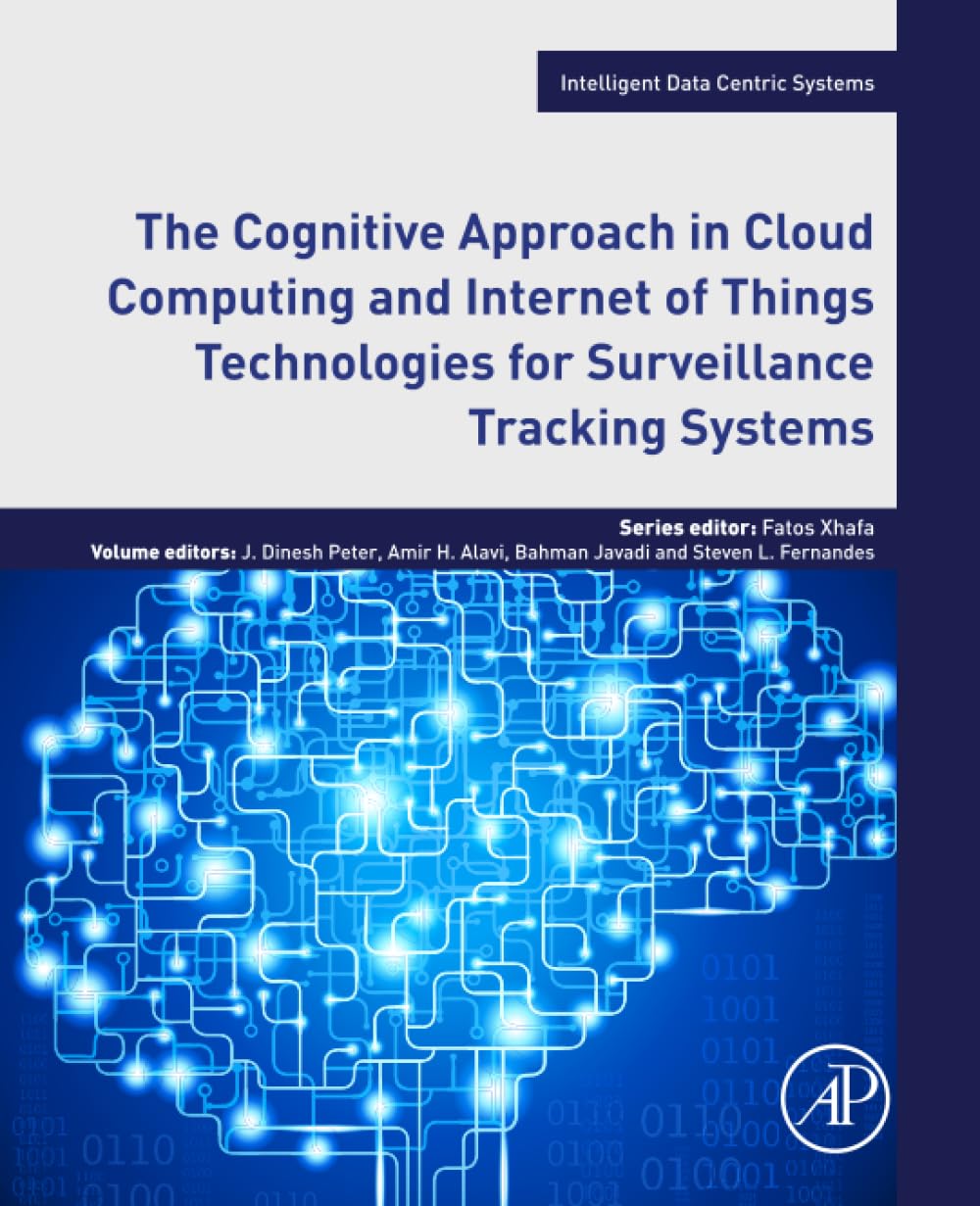
The Cognitive Approach in Cloud Computing and Internet of Things Technologies for Surveillance Tracking Systems discusses the recent, rapid development of Internet of things (IoT) and its focus on research in smart cities, especially on surveillance tracking systems in which computing devices are widely distributed and huge amounts of dynamic real-time data are collected and processed. Efficient surveillance tracking systems in the Big Data era require the capability of quickly abstracting useful information from the increasing amounts of data. Real-time information fusion is imperative and part of the challenge to mission critical surveillance tasks for various applications. This book presents all of these concepts, with a goal of creating automated IT systems that are capable of resolving problems without demanding human aid. Examines the current state of surveillance tracking systems, cognitive cloud architecture for resolving critical issues in surveillance tracking systems, and research opportunities in cognitive computing for surveillance tracking systems - Discusses topics including cognitive computing architectures and approaches, cognitive computing and neural networks, complex analytics and machine learning, design of a symbiotic agent for recognizing real space in ubiquitous environments, and more - Covers supervised regression and classification methods, clustering and dimensionality reduction methods, model development for machine learning applications, intelligent machines and deep learning networks - includes coverage of cognitive computing models for scalable environments, privacy and security aspects of surveillance tracking systems, strategies and experiences in cloud architecture and service platform design A comprehensive guide to applying the cognitive approach to surveillance tracking systems in Smart Cities, Cloud Computing and IoT The recent rapid development of Internet of things (IoT) has focused research on smart cities, especially on surveillance tracking systems in which computing devices are widely distributed and huge amounts of dynamic real-time data are collected and processed. Efficient surveillance tracking systems in the Big Data era require the capability of quickly abstracting useful information from the increasing amounts of data. Real-time information fusion is imperative and part of the challenge to mission critical surveillance tasks for various applications. Frequently, human review of the recorded video is still needed for detecting abnormalities. Even though machine-driven techniques can facilitate the detection of potential abnormalities, processing the enormous amounts of data remain a demanding computational task. Cloud computing has been recognized as an ideal candidate for this kind of Big Data processing, due to many attractive features including high elasticity, good scalability, supporting pay-as-you-go service models, and the capability of overcoming the constraints in both software parallelism and hardware capacities. Cognitive computing is the simulation of human thought processes in a cybernetic model. This model involves self-learning systems that use data mining, pattern recognition and natural language processing to mimic the way the human brain works. The goal of this model is to create automated IT systems that are capable of resolving problems without demanding human aid. Cognitive computing systems use machine learning and deep learning algorithms. Such systems continually acquire knowledge from the data fed into them by mining data for information. The systems refine the way they look for patterns and as well as the way they process data so they become capable of anticipating new problems and modeling possible solutions. Cognitive computing is used in numerous artificial intelligence (AI) applications, including expert systems, natural language programming, neural networks, robotics, virtual reality and surveillance tracking systems. Machine / deep learning is being used to understand “normal” operational behavior across application, infrastructure and network. The cognitive approach in surveillance tracking systems produces a cybernetic model that applies human thought processes using the cloud environment. The Cognitive Approach in Cloud Computing and Internet of Things Technologies for Surveillance Tracking Systems explores the state of the art, software tools and innovative strategies to provide better understanding of surveillance tracking systems in the cognitive cloud environment. The book states the different problems and challenges of the surveillance tracking cybernetic model with various cognitive approaches to yield state-of-the-art results. This advanced publication provides useful references for educational institutions, industry, academic researchers, professionals, developers and practitioners to apply and evaluate this leading-edge research. J. Dinesh Peter is Program Coordinator for the Department of Computer Sciences Tec
| Gtin | 09780128163856 |
| Age_group | ADULT |
| Condition | NEW |
| Gender | UNISEX |
| Product_category | Gl_book |
| Google_product_category | Media > Books |
| Product_type | Books > Subjects > Engineering & Transportation > Engineering > Bioengineering > Biomedical Engineering |