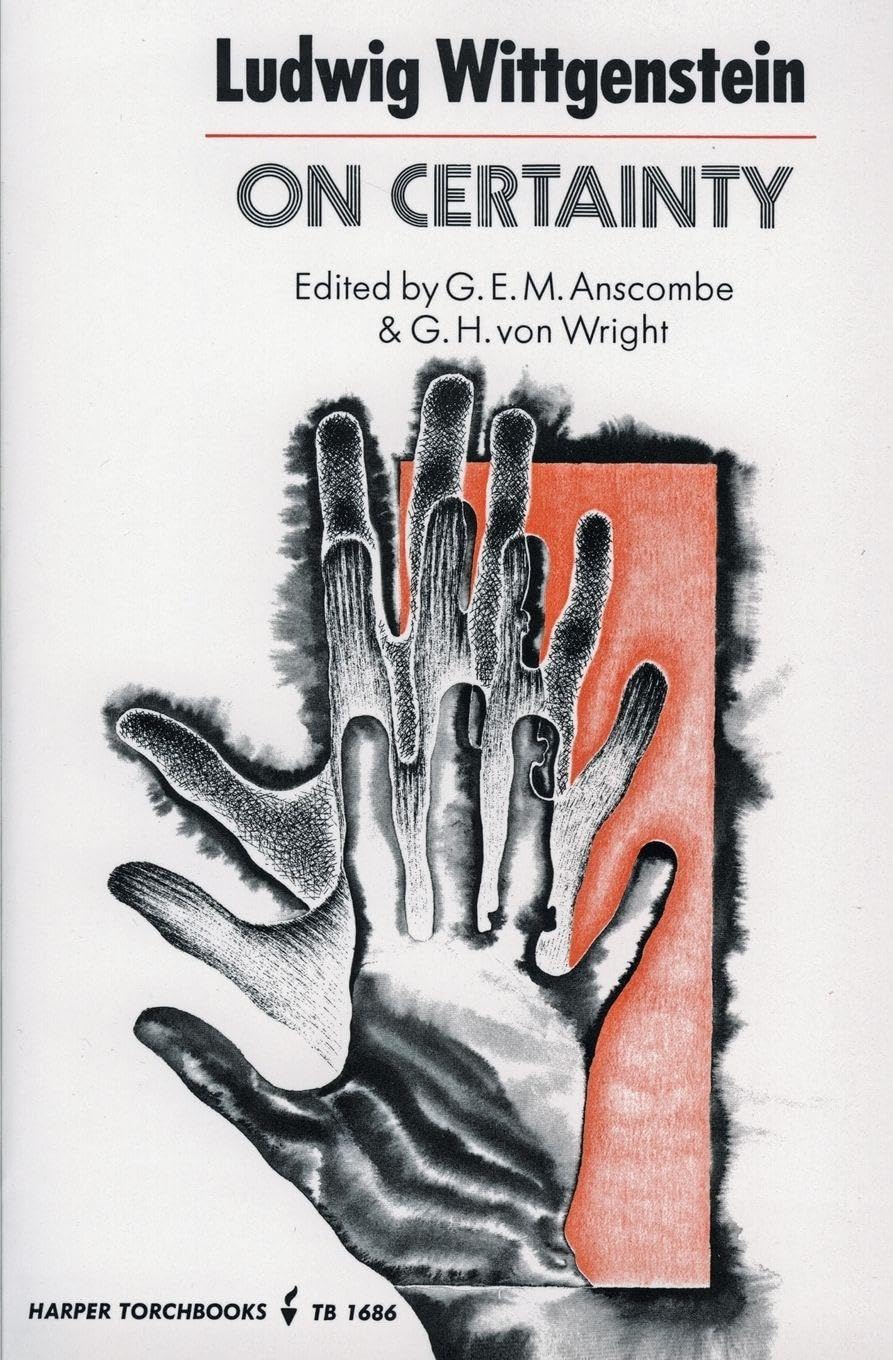
Written over the last 18 months of his life and inspired by his interest in G. E. Moore's defense of common sense, this much discussed volume collects Wittgenstein's reflections on knowledge and certainty, on what it is to know a proposition for sure. "The seventh volume of the Wittgenstein corpus, which contains notes written at the end of his life.... Provides a straightforward guide to the thought of this most complex of philosophers." -- "Bookseller""The volume is full of thought-provoking insights which will prove a stimulus both to further study and to scholarly disagreement." -- Alan R. White, "Philosophical Books""All students of philosophy will want to read it. What it contains is his notes on knowledge and doubt, written in the last year and a half of his life, mainly in answer to G. E. Moore's articles on these subjects." -- "British Book News" Written over the last 18 months of his life and inspired by his interest in G. E. Moore's defense of common sense, this much discussed volume collects Wittgenstein's reflections on knowledge and certainty, on what it is to know a proposition for sure. Ludwig Wittgenstein (1889-1951) was born in Austria and studied at Cambridge under Bertrand Russell. He volunteered to serve in the Austrian army at the outbreak of World War I, and in 1918 was captured and sent to a prison camp in Italy, where he finished his masterpiece, Tractatus Logico-Philosophicus , one of the most important philosophical works of all time. After the war Wittgenstein eventually returned to Cambridge to teach. On Certainty 1. If you do know that here is one hand, 1 we'll grant you all the rest. When one says that such and such a proposicion can't be proved, of course that does not mean that it can't be derived from other propositions; any proposition can be derived from other ones. But they may be no more certain than it is itself. (On this a curious remark by H. Newman.) 2. From its seeming to me--or to everyone--to be so, it doesn't follow that it is so. What we can ask is whether it can make sense to doubt it. 3. If e.g. someone says "I don't know if there's a hand here" he might be told "Look closer".--This possibility of satisfying oneself is part of the language-game. Is one of its essential features. 4. "I know that I am a human being." In order to see how unclear the sense of this proposition is, consider its negation. At most it might be taken to mean "I know I have the organs of a human". (E.g. a brain which, after all, no one has ever yet seen.) But what about such a proposition as "I know I have a brain"? Can I doubt it? Grounds for doubt are lacking! Everything speaks in its favour, nothing against it. Nevertheless it is imaginable that my skull should turn out empty when it was operated on. 5. Whether a proposition can turn out false after all depends on what I make count as determinants for that proposition. 6. Now, can one enumerate what one knows (like Moore)? Straight off like that, I believe not.--For otherwise the expression "I know" gets misused. And through this misuse a queer and extremely important mental state seems to be revealed. 7. My life shews that I know or am certain that there is a chair over there, or a door, and so on.--I tell a friend e.g. "Take that chair over there", "Shut the door", etc. etc. 8. The difference between the concept of 'knowing' and the concept of 'being certain' isn't of any great importance at all, except where "I know" is meant to mean: I can't be wrong. In a law-court, for example, "I am certain" could replace "I know" in every piece of testimony. We might even imagine its being forbidden to say "I know" there. [A passage in Wilhelm Meister, where "You know" or "You knew" is used in the sense "You were certain", the facts being different from what he knew.] 9. Now do I, in the course of my life, make sure I know that here is a hand--my own hand, that is? 10. I know that a sick man is lying here? Nonsense! I am sitting at his bedside, I am looking attentively into his face.-So I don't know, then, that there is a sick man lying here? Neither the question nor the assertion makes sense. Any more than the assertion "I am here", which I might yet use at any moment, if suitable occasion presented itself.--Then is "2 x 2 = 4" nonsense in the same way, and not a proposition of arithmetic, apart from particular occasions? " 2 x 2 = 4" is a true proposition of arithmetic-not "on particular occasions" nor "always" but the spoken or written sentence "2 x 2. = 4" in Chinese might have a different meaning or be out and out nonsense, and from this is seen that it is only in use that the proposition has its sense. And "I know that there's a sick man lying here", used in an unsuitable situation, seems not to be nonsense but rather seems matter-of-course, only because one can fairly easily imagine a situation to fit it, and one thinks that the words "I know that . . . " are always in place where there is no doubt, and hence eve
| Gtin | 09780061316869 |
| Mpn | 9780061316869 |
| Age_group | ADULT |
| Condition | NEW |
| Gender | UNISEX |
| Product_category | Gl_book |
| Google_product_category | Media > Books |
| Product_type | Books > Subjects > Politics & Social Sciences > Philosophy > History & Schools Of Thought > Western > Modern |